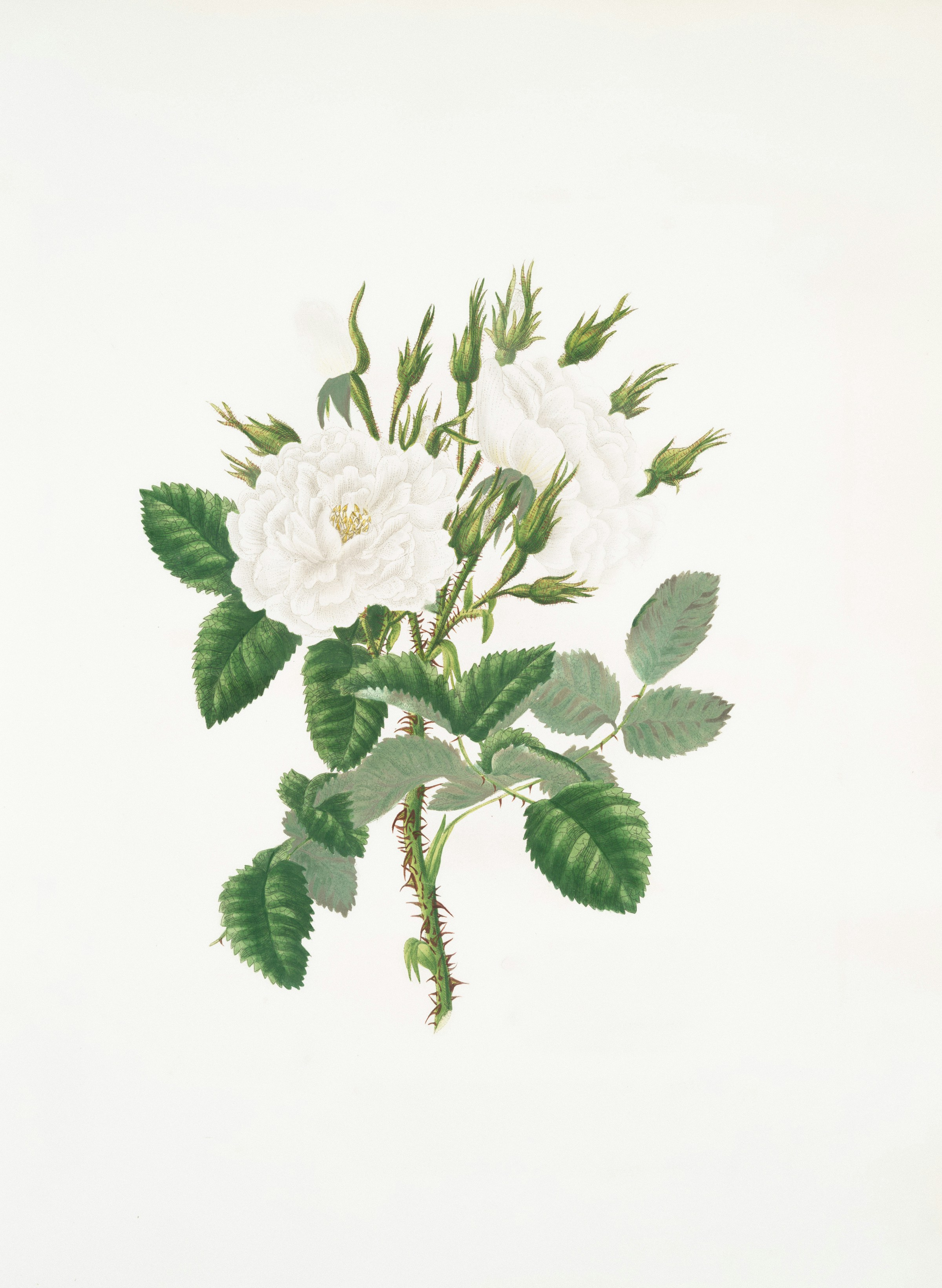
Emma held the rose in the palm of her hand and saw versions of it spread out across time. Ghostly layers in exploded view. The oldest image was a small spiral of delicate white petals. Long and thin like fine bones. She imagined the ancient blossom alone on a windswept field, a stray hoof crushing it, ending the species. No reason. Just bad luck. No one would even know you existed, would they? She felt the sting of tears and wasn’t sure why.
She closed her eyes, focusing on how the present-time flower felt. There was a subtle warmth and moisture where it touched her palm, but she could not find a center. The flower’s or her own. The thing in her hand was neither this nor that. Rootless. Unbound. Time around it was ruined and the uncertainty was an engine spinning off-center, throwing all her senses out of balance. She opened her eyes. Now it was just a flower again.
“These are beautiful,” she said to the nearest giant, a phosphorescent shape looming in from the shimmering, multi-hued chaos outside the garden wall. “But we need water; the garden is too dry.” The being gave no indication that it heard her. She let go of the flower and walked to her tent in the corner of the garden. When she turned back, three giants stood where only one had been. Perhaps the one she had spoken to was among them, perhaps not. She couldn’t tell them apart. It irritated her that she couldn’t tell if any of these were the one she had spoken to. She glared up at them.
“We need more water, you idiots. You ruined the world, the least you can do is maintain what little is left. I can’t very well run to the garden center for supplies now, can I?” She went into the tent, threw the flaps shut and lay on her cot, trembling with nervous excitement. She had no idea if they understood her. Sometimes she felt like her meaning got through, though she saw no real evidence of it.
Emma woke hours later to a soft pattering sound. She got up and pulled the tent flaps open. Raindrops were moving sideways through the garden. It was better than the rain falling up. Which it also did sometimes. Had haranguing them worked? Was this their answer? Or a coincidence? She was wondering if she could insult the watchers into making it rain something like steaks or toilet paper when she saw something that made her gasp. All the rain was flowing toward a patch of plants she had never seen before. Except perhaps in drawings.
Superimposed over the rose bushes were ghosts of giant ferns. Tall as trees. Flickering in and out of solidity. Each frond arched overhead, dipping at the ends, tips just within reach. It was warmer near them. The hotter atmosphere of an ancient environment must have followed the plants into this time.
“Oh my,” she said out loud. “How long has it been since you’ve existed?” She tried to peer into the area around the phantom ferns, a window into the Cenozoic, but the layers of flickering green were too many. The images finally settled down and the ferns became substantial. She reached up, grasped a frond and brought it to her nose. Peppery. Musky. A scent that died out with the dinosaurs. She was likely the first human to ever smell it. The scent still in her nose, she left the ferns, passing through the moon-gate into the outer gardens.
There were more low hedges than trees in the outer gardens, so it was easier to see the gossamer sheets of color that shimmered beyond the walls. The garden may be an island of relative normalcy, but time was not fixed out there. That was wild time. An utterly horizonless place. It seemed to be the natural environment of the giants, but it was definitely not an environment for humans. Emma had seen what it could do to a human.
Her eyes came to rest on the back gate; a little wooden door with a heavy iron ring for a handle. It was closed, braced by the flat paver that leaned against it. The stone was unnecessary. The gate wouldn’t open without twisting the ring. She had leaned it there anyway. She thought of a small hand on the other side of the gate, slipping from her grasp, caught in the change. She had watched it drift away, her own hand unable to move through the shimmering colors. Why didn’t I make her go through the gate before me? she thought for the thousandth time. Then she realized someone was standing right next to her.
“Dammit, Barret,” she growled, “you scared the shit out of me.”
“Sorry,” the man said, “I thought you knew I was here. You looked very serious so I didn’t want to interrupt.”
“It’s okay,” she said, relaxing, “lost in thought, you know.”
“I definitely do,” he said. The man was bald with a wild gray beard. He was in the woolen bathrobe he always wore. Small, colorful flowers were pushed into the collar. He changed them every day or two so they almost always looked fresh. She’d never asked how old he was, but she thought he had to be sixty or more.
Barret was the only American that had been in Bunton Hill when the change happened. He was also the only other person who stayed in the garden instead of the village. He slept in a tent made of ragged canvas tarpaulins tucked among the blackberry bushes. She liked him as much as she could but he had an enthusiasm for their new situation that she found off-putting. She had seen him at the beginning of all this; a normal American tourist. But since the change he’d taken on the persona of a woodsy pagan, wearing the robe and sleeping in the bushes, carrying on about English gardens and folk history in a way no actual British person ever would. She considered it a small mercy that he hadn’t adopted one of those ersatz British accents.
“Guess you saw that crazy rain,” he said, “we needed it, even if it was going the wrong way.”
“Are there any new vegetables?”
“I think there are, but I haven’t gone over to look. Shall we?”
“There better be something,” she said, “we’ve just about finished off the squash.”
“Worry not,” he said, folding his hands in front of his chest, “the Green Men will provide.” He beamed a solemn, knowing smile. She turned away, rolling her eyes. They walked to the vegetable garden together.
New rows had appeared since yesterday. She walked between them, stopping at a vine that twisted around massive gourds. Zucchini? It was green and as large as her forearm. It’s got to be some kind of zucchini only big. The last row held what she was almost sure were broad beans but smaller and brown. She shelled one and bit with her front teeth, carefully chewing and tasting. A starchy green flavor flowed around her tongue. She didn’t really care what it tasted like. It was protein, and god knows they need more of that.
“Miss Emma?” said Barret.
She had almost forgotten he was there. “Yes?” She broke off the end of a gourd and sniffed it.
“I was thinking. Perhaps it would lift spirits if we had a small harvest festival and invited the villagers to it. We could sing old songs, thank the Green Men for their bounty.” He gestured at the shifting colors outside the walls, where the giants were.
“They aren’t Green Men, Barret. Please stop trying to make that a thing. I don’t even think that’s the proper use of that myth or whatever it is.”
“How about spirits of the forest,” he countered, “you can’t deny it fits them; ghostly, watching over the garden and all of us in it.”
“Don’t be stupid,” she said, “they don’t give a shit about us.” She threw the scrap of zucchini into the bushes. “They’re murderers, unconcerned with your life, mine, or anyone else’s. I’m not honoring them or thanking them or worshiping them.”
Barret was silent. She glanced at him and saw he was looking at the garden gate with the leaning paver. She wondered if he had ever opened it. Did he know what was there, just outside, suspended forever in dead time? If only I had let her go through first.
“I’m sorry,” she said. “that was rude of me. It’s just that I have to go meet with Donbass and the rest of them this morning. It has me on edge.”
“No need to apologize. Is he still pushing his stupid plan?”
“He certainly has ideas.”
“Do me a favor?”
“What’s that?”
“Tell him to go shit in his hat.”
She laughed, “Sure thing.”
“Well, I’m off,” he said, bobbing on his heels. “Some of the kids are supposed to meet me in the main garden to pick aphids today. Knock ‘em dead, Doc,” he said over his shoulder.
The village was still mostly intact. The garden’s main entrance was now the only connection between the two places. The village felt like an extension of the garden anyway with its tended roadside beds, patches of flowers and rare trees with brass plaques embedded in the dirt below.
Bunton Hill Garden had been named for the village of Bunton Hill, and Emma suspected the village had survived the catastrophe only because the giants actually saw it as part of the garden. Otherwise it probably would have been shredded across time like everything else. She passed a patch of rhododendrons and trudged up the cobble drive to the hilltop community center. She could hear Donbass before she got to the parking lot—his crisp, unctuous voice bigger than the rest.
“Now we talked about this, everyone must share. There should be no confusion.” There was some squabbling, mostly women’s voices. She rounded the corner and stood outside the open double doors. Ronald Donbass’ large, round face flicked to her when she appeared but he didn’t give her away. She was grateful for that and crept to a seat in the back row. She surveyed the room. A lot of the villagers were here. Maybe fifty. There had been a total of seventy-nine souls in Bunton Hill and Bunton Hill Garden when the world had been ripped apart. Six months later there were seventy-two.
The first death was a pensioner no one knew. It was believed he was in the village for birding season. He died in his sleep within a month of the change. That made seventy-eight.
Three others had wandered into an area where time wasn’t stable. These unfortunate souls were still there, or at least their bodies were, spread out in the moving colors, some parts visible, some flickering in and out. People avoided that part of the village. It had been everyone’s first time seeing what the shimmering colors of chaotic time would do to a contemporary body. They looked very dead. At least there was that to be grateful for; that one could die when such a thing happened.
That left seventy-five. Then three others had taken their own lives in rapid succession. No one was shocked. No one blamed them. Mrs. Onzari uttered what might have been recrimination in her native tongue, but she also closed her eyes and said a long and solemn prayer over each one. That left seventy-two living souls still in Bunton Hill.
“Now Milly,” said Donbass, “there’s enough room for everyone, but we have to share.”
“That’s not right,” said Milly, shaking her head, “that house has been in my family for a hundred years, I don’t think I should be forced to live with anyone.” She turned to a dowdy woman sitting to her left. “No offense, Gail.”
Gail nodded, “None taken, Milly, I don’t want to live with you either.” She turned to address the rest of the room, “I can hear her breaking wind from other side of the house. Like the honking of a duck, it is.” There was laughter.
“Okay,” said Donbass. “Please, if neither of you wants to live with the other, find someone who wants to switch. There’s also the community center garage, which is currently vacant.”
“That’s because it only has a cloakroom,” said Gail, “and barely a kitchen. What about your house, Ronald? Why do you get the biggest house in the village all to yourself?”
“Is there any other new business?” said Donbass, looking around the room and finally settling on Emma. After an awkward pause she cleared her throat.
“There’s beans,” she said. The room became quiet as everyone turned to look. Someone coughed.
“What was that, Dr Plavik?” said Donbass.
“I said there are beans. Oh, and some kind of zucchini. I could use help harvesting, but we should go now. There’s no way of knowing how long they’ll be there.” She heard someone mutter they hated zucchini.
“Right, that’s certainly good news.” Donbass pointed at some men in the front row. “Would you three mind going to the garden and picking what you find? Thank you.” The meeting was breaking up. Emma turned to go. “One moment, Dr Plavik,” said Donbass. “could I have a quick word with you?”
“I really have to go, Ronald.”
He moved in front of her and put his hand on her shoulder. She knew his expression was meant to appear sympathetic but he couldn’t pull it off. It just made him look mildly constipated. She resisted the urge to swat his hand away.
“How are you holding up, dear?” he said, “everything okay out in the garden?”
“Everything’s fine,” she said.
“Have you given any more thought to what we talked about?”
“I still think it’s a terrible idea.”
“But things can’t go on like this. We have no say in our own lives. You might have been the royal gardener or whatever—“
“Director of Science,” Emma interrupted, “Kew Gardens—and I’m a botanist, not a gardener.”
“To be sure,” he said. “The point is you have no authority, if you ever did. You were here on a family vacation, not even an official visit—” he scanned her face for a reaction, but she didn’t take the bait. He continued. “Anyway, we don’t think you’re handling relations between us and the giants properly.”
“Does we just mean you, Ronald?”
He waved the question away, “It’s not your fault, of course—you’re too busy taking care of your little plants to press for our needs, our rights.”
“There is no pressing for our rights, Ronald. I’m not even sure they can hear us, much less understand what we say. I don’t think they give a shit about us.”
“That’s just it,” he said, “we need someone who can negotiate. Make a deal. You can still tend the garden, live there or whatever.”
“Just leave it,” she said, “can you do that? I mean, you’ve got all this,” she waved at the village around them, “just move on to some other scheme and—”
“It’s not a scheme,” he interrupted, “and I’m only thinking about the common good. Which you should be doing as well.”
She snorted. “Oh please, you’re just bothered because it’s a thing you don’t control. You need to leave things alone, they already provide us with what we need.”
“Now you sound like that idiotic American.”
“He’s not idiotic,” she said, surprised at her own indignation. “At least he cares about the garden, which is more than I can say for you.”
Donbass shook his head in a show of disappointment. “I thought you of all people would want to bring these giants to heel.”
“What do you mean?”
“We’ve all suffered loss,” he said, “but you?” He lowered his head, “They took away your daughter, didn’t they? You’d think—“
She slapped him. Hard. It was a loud crack that silenced the room. Everyone turned. Donbass’s look of shock was quickly replaced by indignation. His eyes flashed to the onlookers and Emma knew that if they hadn’t been there he would have slapped her back. Maybe more. She turned and walked out, sparing him one last glance. He was still looking at her, but his round face was blank now. Which was somehow worse.
She had calmed by the time she got to the garden gate. Why did I have to do that, she thought. Now she would have to apologize. In front of people too. Donbass would never stop causing her problems if she didn’t. What an arsehole. There are always men like Donbass. Even here where only a minuscule amount of humanity is left, they made sure to include a fucking Donbass.
She forgot about the incident when she saw a line of people squatting in front of the roses. Barret was at the end, next to the last bush, facing the group. They were mostly young people, including all the smallest children, and the elderly couple Stanley and Dina, who had always lived in the village.
“Now just pinch one,” said Barret, demonstrating on the rose that dangled in front of him, “then you can either squash it or flick it away.”
“That’s all?” said a girl Emma didn’t know.
“That’s all, Madeline,” he said, “you thought it was going to be a big thing, didn’t you? But that’s all there is to it.” They each pinched, flicked, or crushed. One of the girls let out a protracted ewwww that made everyone laugh.
Emma sat down with them and began picking aphids herself. Dina nudged her and opened a palm, proudly displaying a tiny pile of the insects. Emma nodded appreciatively. “A small number of aphids in a garden can be beneficial,” she said, “it’s only when there are too many of them that they can cause trouble.” She held one of them up to the light, trying to make out its tiny features. “Sometimes a good hard rain can wash them away, but if that doesn’t happen, a gardener will have to take more drastic action. Like soap and a garden hose.” She considered the aphid for a moment more, then without really knowing why, pushed it gently off her finger and onto a dandelion leaf below the bushes.
Loud voices woke her up. The volume was increasing as she dressed and by the time she left the tent there were sounds of a struggle. A crowd of people stood next to the rose bushes. On the ground in front of the crowd was Barret, holding his jaw.
“What’s going on here?” she cried, moving to help Barret.
Donbass separated from the group. “Oh good, you’re here, we can take care of this all at once.”
Barret was gesturing at the crowd. “The roses!” he squealed, “Miss Emma, they’re uprooting the roses!”
Now she saw the group in the center of the crowd had dug up several of the rosebushes and were transferring them to pots, all of them too small. A pile of lumber—what looked like the remains of a dismantled shed—lay on the ground next to the flowerbeds.
“We are temporarily moving these plants to the community center,” said Donbass, “where they will be held inside, under a roof. In their place we will erect a structure from which to parley with the giants. We will deliver our terms for the return of the roses.”
“You’re killing those plants!” she shouted, slightly amazed at her concern for the flowers instead of the rest of this situation. They were moving down the row, their spades cutting through roots, half the plants already gone. “Ronald, you fucking idiot.”
Donbass gestured. “John, Simon, please make sure Dr Plavik and the hippie don’t interfere.” The two men came forward, standing between them and the rest of the group. She was about to protest when she felt something strange, like a change in air pressure. She bent down to help Barret up and whispered in his ear.
“Do you feel that?” she said.
He nodded. “It started when they dug up the first bush. Look.” He pointed beyond the crowd. Giants were lined up outside the wall. She panned around, alarmed to see them everywhere. She had never seen so many at once. They were watching.
“Get up,” she said, “we have to go.” They backed away from the group, moving toward the outer garden. Almost everyone in the village was there, either watching from the main gate or standing inside. “Donbass!” she shouted. “I think you should stop what you’re doing. All of you should just stop what you’re doing right now!”
Donbass turned to reply but then noticed the giants for the first time. “See?” he said. “We haven’t even built the embassy yet and they’re ready to negotiate. See how easy that was, Emma?”
But the villagers had stopped digging. Several dropped their shovels and backed away. Donbass, oblivious, gestured to the group with the potted flowers. “Take those to the community center right away and I’ll talk to them.”
Emma and Barret were easing into the outer garden when Donbass started walking toward the giants, giving a spiel she couldn't hear. That was when the first villager was taken. He was a burly man Emma didn’t know. The only one still digging. He flew out of the garden and into the village, where his body stopped, suspended just off the pavement. He began to stretch out, colored tendrils of unstable time pulling in all directions. There was a cracking sound that reminded Emma of growing bamboo. It was the man’s bones breaking. His jaw moved soundlessly, his eyes casting back and forth. He was still alive. Screams erupted from the people.
Later, Emma would consider how curious it was that all the people in the garden that day suddenly and without direction divided into two groups. It seemed to be instinct. Some fled to the village. Others fled deeper into the garden. By then, the people who had been uprooting or carrying the plants were flying out of the garden one after the other, stopping wherever they came into contact with wild time.
Only when the fourth villager had flown out did Donbass notice. He turned in time to see one of the men coming apart. His eyes went wild and he broke into a run. A guilty thought struck Emma then, that she might have enjoyed the terrified look on his face if she hadn’t known he was about to die.
He got farther than any of them before he was taken. He yelped as the wild light grabbed him in the community center parking lot and suspended him there. By then, the same iridescent effect was spreading over other parts of the village. The words garden hose and soap came unbidden to Emma. She and Barret were standing together, along with the group of people who had fled into the garden, many of whom were crying. They could hear strangled cries coming from the village.
The noise stopped after a while but the chaotic, shimmering effect of broken time remained in the places it had sprung up. Those in the garden stayed huddled and still under the moon-gate for the rest of the day. They slept there, piled together. But Emma didn’t sleep. She sat next to Barret all night. He was restless but snored softly until morning. When he woke up she helped him off the ground and they walked into the village together.
The villagers suspended in the air were dead. The first man was spread out in pieces, most of him missing. Emma and Barret moved carefully on the cobbled walk. A thin, weaving path of safety cut through anywhere plant life still existed. At one point the shimmering walls of death were less than five feet apart so they walked single file. They finally came to Donbass. Emma gasped. He was still alive.
His mouth was stretched down, the skin around one eye pulled out of shape, the bones behind it gone. His legs were crushed. Shards of bone and tissue floated here and there. A constellation of gore. His torso flickered in and out of existence. The one visible eye darted from Emma to Barret and back again. Emma heard Barret make a noise. He was crying. She put a hand on his shoulder.
“Isn’t there anything we can do?” he said.
She shook her head. “You know there isn’t.” As they watched, another transformation occurred to Donbass. His head disappeared. It was somehow better.
Emma sat in front of the small door. The heavy paver lay to the side. She’d cried for a long time but was finished with that now. She was glad she’d opened the door. If she hadn’t she would never have known.
There was no longer any trace of her dead daughter’s time-ruined body. In its place was a single white rose. It grew from a vine that was half-in and half-out of broken time. Small and delicate. Ancient petals like fine bones. She could smell it from where she sat; a powdery, honeysuckle scent that made her think of Spring.
A giant was sitting in the shimmering landscape just outside the open door. What she supposed was a hand, or maybe a finger, touched the part of the flower that was on its side. Emma extended her hand and caressed the petals on her side. She thought of the aphid, the one she had let live, and was about to ask a question when the giant suddenly vanished. After a moment she walked away. She left the wooden gate open. The flower was still there.
Near the center of the outer garden, young people were dancing around a scarecrow. The effigy was made of fallen branches, a garland of flowers on its head. Barret was singing some old-sounding song—Emma couldn’t tell if it was made up or a real song from before—but she had to admit he had a decent voice. She plopped down next to Stanley and Dina and picked up one of the enormous dates they’d gathered that morning.
“Those are incredible,” said Dina. “I have got to stop eating them.”
“These probably haven’t been eaten by humans for thousands of years,” said Emma. “Just call it making up for lost time.” She bit one of the sweet fruits in half. “Man, that’s good. Just be careful, too many can give you a case of the trots.”
“Have you been to the new garden yet?” asked Dina.
“No,” said Emma. “I’m scared to. I’m thinking of sending Barret instead.”
“But they’ll think he’s the most important person in our garden,” protested Dina. She touched Emma’s arm. “It should be you, dear.”
“I’m not sure that matters anymore,” said Emma. “I think we’re just as well off without leaders. Come on, let’s go look.”
They stood together at the far wall of the outer garden, looking over at the strange topiaries and vines beyond. An alien garden was attached to their outer wall. Creatures about their size, pink-skinned with clusters of blue circles she supposed were eyes, stood in the other garden, swaying from side to side. A new gate, roughly the size of the two species, was at the spot where the walls touched. One of the beings raised an appendage. Was that a greeting? She raised her arm and waved. Had they lost people they loved? Would we be able to communicate?
She lowered her arm. Maybe tomorrow, she thought, and went back to watching the children playing tag. They laughed, their quick forms darting between the trees.