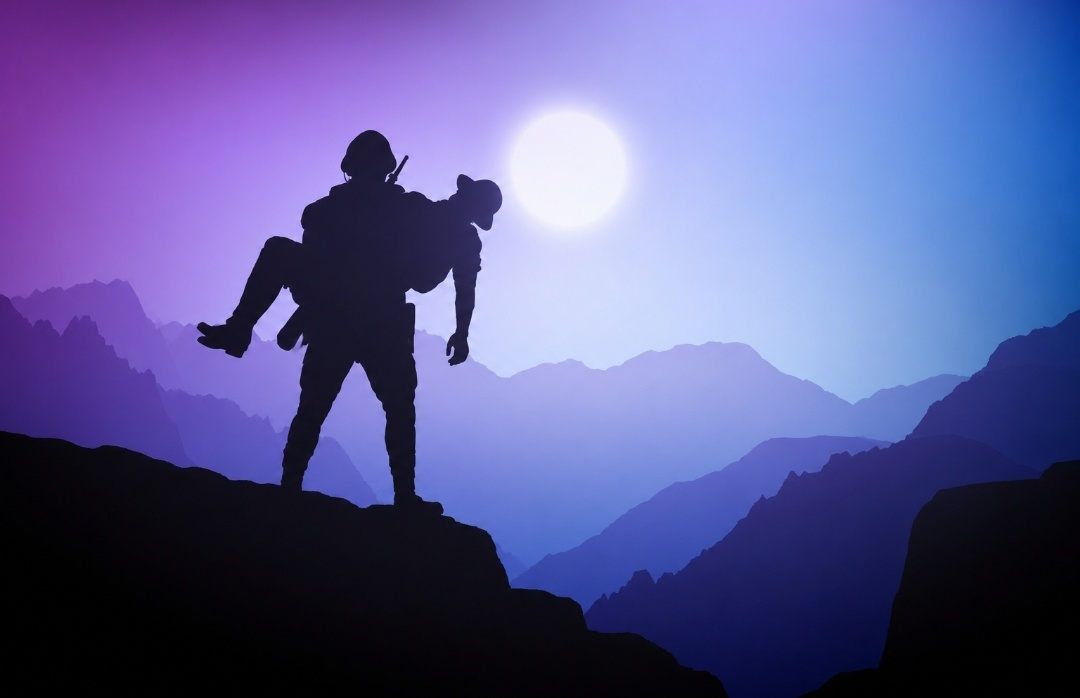
“Bossing, I got you,” I screamed into my helmet’s intercom as I carried him to the end of the flight deck. “Don’t you die on me now!”
No response.
The CPO, Chief Petty Officer Angelo de la Cruz, could have died by the time I got to him three minutes ago. I didn’t know: his suit was offline, shot up by a topsider’s E.M.P. blaster, so I couldn’t read his vitals. But either way, my crew doesn’t leave a man behind. Walang i-iwanan, we always say. It was true in Basic, it was true in A- and C-school, and it was true now.
Boosters engaged.
“Crew, cover us—jumping starboard,” I yelled, switching to the main intercom that the strike crew used. As I switched my comms, I heard the commotion of every other seaman in our sub-batch of 30 scrambling to figure out exactly what the hell was going on. A couple of voices—Aquino, Ramirez, and Morales, all strikers that my radar indicated were flying by to the right of the carrier—responded affirmative, and soon enough, I saw ballistic missiles soaring through the tear in the hull.
I took the CPO across the deck to the gaping hole as far as my legs could carry us, wincing from overwhelming pain as the adrenaline washed away and the burn of the fibromyalgia hit me hard, and let the booster jets take us the rest of the way. I could just leave him here. My joints flared up. It would be so easy to leave him here. I held onto my CPO tighter, knowing that if I loosened my hold just a tad, I would let go all the way. So I kept running.
It was a straight shot to—
I felt the very air shake as the reactors that powered the USS Neil Armstrong exploded—they began to go supercritical and tear the systems apart. Space had no “air,” not for most, but our powersuits were designed to harness the energy of what they called the Casimir field and attune themselves to its vibrations. The theory of it is way beyond my enlist’s paygrade—not that I paid attention to it in A-school anyhow—but what matters to us seamen is that the coupling of man to non-matter allows us to literally feel the cold breath of space and adjust ourselves to the quirks of the wind like an ancient seafarer would set his sail.
Any one of our carrier’s resident engineers could tell you that a nuclear reactor going supercritical would astronomically alter the vacuum expectation value of whatever-the-hell and eff-his-life any living being that stood too close to it by boiling him alive and ripping him to shreds with heatwaves and nuclear radiation. A seaman’s powersuit absorbs all that; the worst it does is hit him square on like a punch in the gut. Though in our case, it was more like being rammed by a train moving at full speed.
And ram us it did.
I held onto the CPO as tightly as I could as the blast knocked us off our asses and out of trajectory. It was all I could do to thruster-jet us away from any floating debris from when the fuel hose—that’s sailor-talk for giant goddamn space worm—tore into the ship like it was a sandworm tunnelling through the sandy sea.
“Shit,” I exclaimed as we were kicked off-course. I had set my suit’s nav to jet us across the open battlefield, theoretically fronted by our strikers on starboard, to get to the USS John Young.
The intercom buzzed and—“Garcia, okay ka lang?”—one of my crew asked.
Hell, no, I was not alright. My CPO and I were tumbling off-course into deep space and—
Swoosh!
—topsider missiles were shooting past us at Mach 10. It was a warzone out here. And my CPO and I were trapped out in the open like drowning boys stranded amidst a sea of sharks. But unlike a drowning boy, who could only hear the sounds of the wind and the waves and his own shrill cries, I heard everything.
See, that’s the thing about having a Casimir field-coupled suit. It’s meant to pick up the vibrations of everything around you and make you feel at one with nature. But that means it picks up. Every. Goddamn. Thing. From the beating of the John Young’s mounted subcalibers to the shrill noise of a passing projectile to the space-shaking collapse of the Neil Armstrong, the sights and sounds of it all were funneled straight into my helmet. Space combat, with all of its three-dimensional charms, was infinitely worse than ground combat. I fought the urge to puke. All of us seamen were trained in Basic to channel out the noise and attune ourselves to what we needed to hear—to echolocate the location and direction of a ballistic; to calibrate our handweaponry on an invisible and electromagnetically cloaked target—but today, as I floated through space on the verge of shitting myself, all of that training went straight down the drain.
I jetted myself around to get a better view of my carrier ship. It was a magnificent sight, if one could describe a literal meltdown as magnificent. Shrapnel and debris orbited close around the carrier and its failing gravitational field, and rays of white light shone through the thickening cracks in the interior shell that hid the nuclear systems of the Neil Armstrong—or CVN-A969, as the bosses’ bosses preferred to call it—from the rest of the ship. I could feel the heat beating down on my crystal visor, the pressure of the Casimir force pushing against my powersuit. I held onto the CPO as if for dear life. The light enveloped me and—
“What’s your name, recruit?” the drill instructor barked inches from my face, spittle flying onto my skin.
“Seaman Recruit Andrés Garcia, sir,” I replied, my heart beating a thousand times a minute. It was my first day in Basic when drill instructor Ernesto Navarro—the only other Filipino at Camp Artemis—laid it thick into me for the first time.
We were young, dumb, and didn’t know what the hell we were signing up for, me and my division of 80. Camp Artemis, the boot camp on the western edge of the moon’s Shackleton crater, was our training ground. You know how the boots on the ground say Basic is hell? Oh, bossing, our version of it makes ground Basic feel like an effing picnic. I don’t care how many miles ground recruits march in nasty weather. I don’t care what kind of man-overboard drills they do for ground sailors. Try belaying up and down a crater in nothing but a skinsuit and a glorified fishbowl for a helmet with three hundred pounds of gear weighing you down. That’s how much a dead powersuit weighs, conservative estimate, and even with moon gravity, it sure isn’t easy. Try maneuvering your powersuit at 90 miles per hour—they can throttle past max on a station wagon’s speedometer—as a recruit, and you’ll learn what fear really means.
“What’s your make and model, recruit?” Navarro asked me one day.
“Strike fighter squadron, sir,” I said giddily, like a child being asked what kind of candy he wanted. “I’m looking for deployment.”
He whistled. I couldn’t tell at the time what kind of whistle it was: the impressed kind, or the disappointed kind. I only have the barest inkling of what it is nowadays. “Deployment’s tough,” he said, “real goddamn tough. You’ve got to have a thick skin about you, boy. Do you have what it takes?”
“Yes, sir, I do.”
“Why deployment?”
I had just broken up with my girlfriend of three years and had nothing going for me, so I wanted to—hell, needed to—ship off and fight a war I couldn’t win. “I want to serve my country, sir.” That—and it felt damn good to be part of an outfit you could be proud of. I needed the Navy as much as it needed me and others like me. It was the kind of community I had never had before.
“You know, I have just the place for you. If you get through Basic and schooling, that is. You ever heard of the Pinoy Boys?”
“No, sir.”
“They’re an all-Filipino crew aboard the USS Neil Armstrong. It’s an outfit part of VFA-111A.”
“Angel Baby, sir?”
“The very one.”
VFA-111A or Angel Baby, as it was callsigned, was a strike fighter squadron notorious for its many underdog battles against the topsiders. My heart raced just thinking about it.
“Do me proud in Basic,” Navarro said, “and I’ll make sure you get a spot on the crew.”
I nearly flunked out of Basic three days later.
We were running combat training out on the dark side of the moon, me half-asleep in my powersuit out of sheer exhaustion, and my man and I in defensive formation against an array of AI bogeys with live ammunition. It was my division’s first taste of live-fire combat, and I was a deadly mixture of fatigue and fear. We were pinned down in a tiny crater five miles from the drop zone, with no visibility, one of three duos left standing. Robot “topsiders” with E.M.P. blasters were swarming all around us, and it was all we could do to blast them out of the sky like it was an arcade shooter game.
I made two mistakes that day.
The first, and probably the worst: I left my man behind.
We were trying to escape the crater and take high ground to run an offensive retreat toward the drop zone when my man, an Australian import, was immobilized, shot in his back thrusters. It wasn’t a full offline, but he couldn’t jump anymore. Legs gone. Told me to leave him behind, no use carrying dead weight. I agreed. So I jumped and nearly reached the drop zone when—
—my second mistake: I didn’t stay frosty.
I spotted what I thought was a friendly coming my way and didn’t bother to check his signature, which I should have done just in case he was a topsider posing as a friendly, and was blasted to bits. I was barely feet off from the drop zone.
Oh, boy, did Navarro lay it thick into me.
On line formation post-exercise, Navarro grabbed me aside and said, “Seaman Recruit Garcia, you’re going to need to learn two things if you want to keep your boots tied tight. One, stay frosty. And two, never—never—leave a man behind. Walang i-iwanan.”
We never anticipated an ambush from the topsiders at Sector 30-ZA. But then again, it isn’t much of an ambush if you anticipate it, huh? Guess stay frosty didn’t stay in our vocabulary for very long. Deployment has a way of pushing you off your toes in a way that I just can’t readily explain.
Sector 30, off in the far edges of Andromeda by the Mayal II cluster, is strictly off-limits to wartime activity for worlds in the Local Group as set by the laws of the Transgalactic Treaty of 2079 A.D. The topsiders, more formally known as the Free People of the Triangulum Empire, have been at war with Earth for three decades, barely years since we as a planet were introduced to the shapeshifting alien race. It’s all high school galactic politics shit; that’s as far as I know. All military school taught me after that was: if it looks like a topsider, breathes like a topsider—shoot the hell out of it.
Not that it was particularly easy picking out a topsider from a lineup of other assorted aliens. They weren’t exactly shapeshifters, per se, but they weren’t not shapeshifters, either: topsiders look different to every person. Some say that they take the form of your worst fears. It was some sort of insane genetic psychic manipulation crap I never could wrap my head around. Hell, one of my batchmates from Basic who was assigned to VFA-309B said they looked like the Skinnies from Starship Troopers. Imagine that! The poor boy had read the book back in boot camp and never could get it out of his head.
Anyway—thirty days prior, we were treading through what we thought was neutral territory. It was supposed to be a quick stop through Sector 30 for a couple of weeks as we took a breather from half a year’s worth of travel.
You know, I wasn’t even supposed to be on the Neil Armstrong when the ambush happened. I had failed my pre-boarding medical examination, and my examiner told me I wasn’t fit for deployment anymore. When they scanned me up in those machines of theirs that could detect everything wrong with you to a fraction of an atom, they found an array of worrying medical conditions that could make you wince just thinking about it: shin splints, patellofemoral pain syndrome, fibromyalgia, a herniated disc. I was a walking case of maybe-don’t-join-the-military. Not that I wouldn’t have enlisted had I known about how much deployment could mess you right up. But maybe I would have signed up for waystation duty instead.
I had been deployed eight times in the nineteen years I was in the force, all as part of the Pinoy Boys. No wife, no kids, nothing—so I signed up for the ship every chance I got. Needs of the Navy, or some crap like that. But each passing deployment wore me down more and more. By 42, when I failed my exam, I was considering handing it in to medboard and calling it a day. I had enough disqualifying conditions to get me up to rating for a medical discharge. It was Navarro—it was always Navarro—who, now a warrant officer running desk duty, called me up and laid it thick into me again.
“Garcia,” he said over the phone with his usual barking tone, “you know you’re hitting pension soon, yeah? Twenty years. You’re—what, nineteen in? If you hand it in now, you’re gambling your pension away. Even if the medboard rates you up 30% and sends you off with disability pay, you’re giving up CRDP—you know what CRDP is? Concurrent Military Retired Pay and VA Disability Compensation. A seaman in most circumstances can’t receive both disability comp and retired pay at the same time—you’ll have to let go of one or the other. But if you’ve wrapped up at least 20 service credits by the time you retire from the Navy, you’re a done deal on basically doubling your entitlement amount.”
I had to admit, it was a damn sweet deal. I only had to tough it out for one more year. So for my 20th and final year, I signed up for my ninth deployment.
At 23, I was a run-of-the-mill Target employee barely making rent—I had been working there for four years. I was three years into a barely steady relationship with a high school galactic politics teacher. I didn’t even like her all that much; she was a nice enough lady, but she and I had nothing in common.
I was what you might call a deadbeat.
I didn’t have big plans or a family to care for or anything of the sort. Hell, I didn’t even have a retirement account. I had never intended to serve. In the beginning, I was just happy enough to be in the States and out of the hellhole I grew up in. But the longer I lived, the more I agitated over what that truly meant.
I wasn’t worth shit to anyone.
Nobody would care if I lived or died.
When the manila packet came in the mail nearly twenty years ago, with the big, bold words: JOIN THE U.S. NAVY, I could have thrown it out. I could have just not opened the packet and closed that door forever. But something in me, something I can’t explain, just gravitated towards it: it called to me, in some crazy way. So I did it. I opened the packet and out came a brochure and a set of forms. I saw the brochure first.
Steady paycheck, it read. I would start at the lowest enlisted rank, E-1, with base pay equivalent to my Target income. But the opportunity to rise through the ranks pulled at me. I wasn’t sure I’d ever make commissioned officer—but imagine Petty Officer Andrés Garcia, making twice my current salary.
Housing and food allowance. I was spending basically all of my money on food and rent at the time. An allowance meant savings. And savings—well, it would be a life of luxury for me.
Healthcare. Something I never had. Healthcare wasn’t meant for people like me, people who were expendable, people who were forgotten by society. Healthcare meant I truly was an American, somebody whose life was worth saving.
And finally: Community. The opportunity to serve your country. The States were my home, now. I wanted to be part of something bigger than myself. I needed to be part of something bigger than myself.
If you had told me thirty minutes ago that I would be taking drill instructor Navarro’s words to heart, I would have laughed in your face so hard I might have died. It wasn’t that I was a selfish sailor. Hell, no, I had long learned to play nice in my nineteen years on the force. But I was raised to take no shits and give less, and it was a hard bet breaking that philosophy out of me—military or not.
I was asleep in the berthing on the top bunk, CPO on the bottom. We were supposed to have made it to the waystation by end-of-day so there were no scheduled flights that day. It was a godsend for the first couple of hours of soundless sleep—no strikers taking off and landing with the loudest sounds you’ve ever heard. I used to be a light sleeper, so in my first few deployments, I slept with either earplugs or headphones, but I got the habit kicked out of me soon enough. Some seamen say that the sound of the strikers crashing into the arresting gear is what lulls them to sleep. I don’t believe it for a second.
What woke me up wasn’t the explosions that rocked the ship. It wasn’t the yells of my fellow boots as they rushed to the scene. It wasn’t the banging of guns fired in the echoing halls of the sleep deck. It was the shrill cry of a rabid topsider. I dreaded the noise each time I heard it. And today was no exception.
I woke up with a start, nearly falling off the bed in my basketball shorts and tee, and came face-to-face with him. He looked exactly like... me. Without another word, not a single thought, I rushed the creature and knocked him to the ground, unconscious. I couldn’t do anything more at the moment without any of my gear. I looked to the bottom bunk and found it empty: the CPO must have woken up first. My mind went blank as I sprinted to the armory and jumped into my powersuit. My joints clicked as I ran, and I nursed my hand where the pain of the punch pinched into me.
WARNING! WARNING! HULL INTEGRITY AT 30%.
The second I got to the flight deck, panting as I ran in an offline powersuit still trying to crank itself on, a fuel hose breached the shell that enshrouded the top of the carrier ship. It tore into the Neil Armstrong like it was paper and rammed straight into the nuclear core, taking half the primary cooling system with it.
WARNING! WARNING! NUCLEAR CONTAINMENT BREACH.
The flight deck was a mess of people, all running in various directions. Some in powersuits, boost-jumping across the freshly made tear in the ship, guns in hand. Strikers unlatched and made do with their halved flight deck and flew out into open space. I spotted one or two seamen running to medbay—no doubt to medevac the hell out of here. Hell, I had half a mind to get out of there myself. It was my last deployment, and I was only there to cash in my 20 service credits.
Then I saw the CPO. On the ground. I couldn’t read his vitals.
Walang i-iwanan.
Where I grew up, it was every man for himself. We didn’t have to worry about topsiders or drill instructors or anything of the sort—but it was its own kind of tribulation and a different beast entirely to live and die in the Philippine slums. I didn’t know my family; I was given away at birth to some no-name gang in metro Manila. And no, this isn’t some sob story about how I grew up poor and alone in the big city. But the world I lived in had its own fair share of troubles, ones that stuck with me to this day.
The Philippines were trying to devise their own space program, and it was slowly sapping the country dry. They wanted to be a nation of the world, to erase the mistakes of the past, all while repeating them to a T. Long hours and little pay to construct what was meant to be the world’s greatest rocket ship. Tourism became a major source of income for the country, and the workforce grew dependent on the industries it generated. The rocket finished construction the year I was born. And it exploded on launch the day of my birth. Thirteen years of labor and tens of billions of dollars later, and all we had to show for it was a smoking pile of rubble.
It sent shockwaves through the national economy.
Industries collapsed, tourism died out, and the national GDP was slashed to bits. The unemployment rate skyrocketed to double digits, and the world as many people knew it fell apart. Other countries pulled out of trade deals as merchant middlemen—trading corporations and the like—got antsy and backed away. The country became a shell of what it once was.
So the first thing I learned was: it’s you against the world.
I was twelve when I witnessed my first shootout. There was no shortage of those in the country. I was fifteen when I bagged my first kill. I remember it clear as day. I was eighteen when I finally got out of the gang and flew to America on a stolen plane ticket. It was a bumpy landing.
“Garcia,” a voice called out over the crew’s intercom. “Get ready for a bumpy landing.”
I swivelled around with boost assist, still clinging to my CPO, and found a medevac barrelling towards us.
“Holy sh—” I yelped, putting a hand in front of me as I braced for impact.
At the last moment, the vehicle jerked rightward to reveal an open door, and my CPO and I tumbled into it. Reckless maneuver, but highly effective. I mean, hey, it worked.
“Hot damn,” the man inside exclaimed. His powersuit had the insignias of the eight-pointed star and a weeping angel—the symbols of the Pinoy Boys and VFA-111A, respectively. “Petty Officer Garcia—Seaman Recruit Linus Agustin. At your service,” he said, craning his neck around to face me from the center console. “Walang i-iwanan, diba, bossing?”
As the door to the medevac shut and the airlock went up, we took off our helmets and gave each other a knowing look. The boy looked barely twenty. This had to be his first deployment. And perhaps it would be his last. Still, he smiled. There was no situation in the world—hell, the galactic cluster—that could be worse than the near-certain death he was facing, and yet... he smiled. Hell, I couldn’t help but smile myself at the thought of it.
I chuckled. “There’s only one place you could have truly gotten that drilled into you. Who was your Basic instructor—Navarro?”
“The one and only, sir.” Agustin offered me a shit-eating grin, then turned back to his flying duties. “Is CPO alright?” His gaze turned to the downed man next to me.
I unhelmed the CPO and checked his pulse, two index fingers to his carotid. Faint, very faint—but he was alive. No man left behind. No goddamn man left behind. Relief washed over me, and the tips of every limb tingled as I came to terms with my accomplishment. I had done it. I had really done it. But it wasn’t over just yet.
“To the John Young, then, bossing?” Agustin asked, pumping up the medevac’s boost.
I looked out at the scene beyond the little dingy spacecraft we were in. Most of the carrier strike group was downed. Nine ships: missile cruisers, destroyers, and submarines—in space, a sub is a capsular craft equipped with cloaking capabilities—all forever out of commission. Debris everywhere. In the far distance, topsider ships closing in from all sides. The John Young was the only one left standing. Myself, I wasn’t faring too well, either: my back was giving me hell for lugging along a downed man and his dead powersuit. I had every right to get myself, my CPO, and my recruit out of this situation. We were close enough to the nearest Earth-aligned waystation that we could have made it in the medevac with the boost set to max and a perfect slingshot around a nearby dwarf planet. But that would have left thousands of men still fighting for their lives and their homeland against the surrounding topsiders.
And no man left behind.
Walang i-iwanan.
“To the John Young, recruit,” I said, no hint of fear in my voice. “That’s an order.”