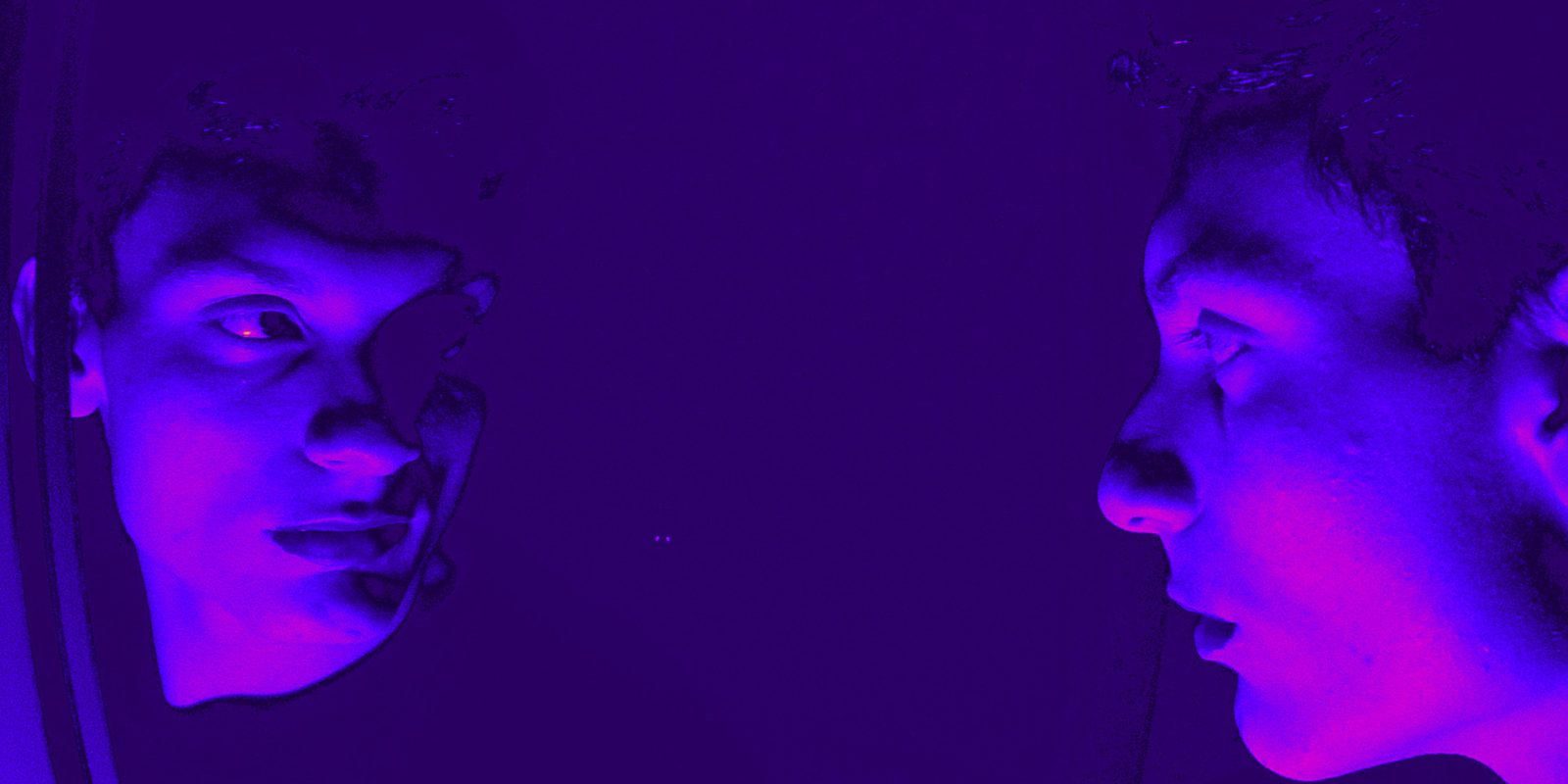
The window is slick with my forehead sweat. A shirtless man wrapped head-to-toe in white fur pelts picks at a fresh wound on the crown of his head, massaging his scalp with bloody fingers. Peeking around the front of a car, he jogs through standstill traffic to the other side of the street. His eyes meet mine as he glances over his shoulder, a smooth visage, his features a dissatisfied artist’s half-finished sketch of a face. Something’s missing–the wrinkles under his eyes or what’s supposed to be behind them–only the dull sting of outside stimuli keeping him in motion. A trail of blood trickles down his head into one of his furs as he disappears into the herd.
I can’t see a crash ahead of us, just a scaly, monotone snake of white cars stretching around parking garages and skyscrapers, cheap homes for exorbitant prices in every direction. All the cars look the same from up here, smooth roofs with aerodynamic lines engraved in them. A woman three cars down is completely asleep in the main seat, the man in the car next to her sneaks a few sips from a shiny gold can, then stashes it in the glove compartment. They’re both wearing nice business-casual wear, sneakily expensive button-downs and freshly ironed pants, socks with higher thread counts than my bedsheets. They recline back, almost in unison, and enjoy the private air conditioning and sound massage as their driver-grade Mirrors handle traffic for them. It may lead to mass gridlock, but I bet it’s really nice. Nicer than sitting on this bus at least, which probably hasn’t been upgraded since before I was born. It smells like fumes, and I have a sneaking suspicion somebody forgot their lunch under one of the seats a few days ago.
The rusted, thin-metal roof has holes melted into it from sitting out in sunstorms, and beams of light shine through them onto the rotating ad screens below. The ads are for stuff like “Arno’s Cheap Insurance,” and “Union Busters: We know the loophole!” I’ve seen them all before. A medical class-action ad rotates onto the screen across from me showing two identical women standing side by side. “Was your Mirror installed before your eighteenth birthday?” it says. “You may be entitled to discounted separation surgery.” Discounted by how much? Probably a few hundred bucks at best. Sure, I’d qualify, but it’s not worth the risk. I’m not gonna pay to be an experiment.
I was twelve when I got my Mirror. Two and a half years on the market and they’d become impossible to avoid. Mirrors were retirement gifts, vacation souvenirs, Valentine’s Day presents. Everybody wanted one, and everybody who got one gave the same positive reviews: A digital clone to facilitate external communication, a simple, non-invasive cranial implant vetted by medical professionals that improved focus, monitored mood, and maximized productivity. Yeah, there were some protests, but who gives a shit about those? I mean, really? Dissenters dwindled while Mirrors grew into lifelong guides, companions, and decision makers necessary for long-term careers. They became part of life, and Mirtek implanted itself in the skull of society and global politics.
My best friends had Mirrors before I did. We were children–we didn’t need them for work and they were still banned from schools–but they’d let their Mirrors chat all day and I had no idea what they were talking about. I’d say something and they wouldn’t even notice. My parents drove me to the Mirtek outlet a few months later.
The technicians matched my physical appearance down to the follicle, scanned my brain and took my DNA. They chipped away at a replica of my psyche until its mannerisms were in lockstep with my own. Then they shoved it on a chip and sewed it in my head. One quick surgery and I had my own Mirror, and for the first time in my life I saw myself how the rest of the world saw me. It’s incredible how easy it can be to have a conversation with yourself: No social pressure, no risk of failure. Eventually I stopped talking to other people entirely.
“I remember when you picked me out at the pound,” Junior says as he materializes in the dirty seat next to me. “I had the saddest, sweetest little puppy dog eyes you’d ever seen and you just had to take me home.” He sighs and shakes his head.
“That’s not how I remember it,” I say as I wave my hand through his translucent face. The freckles in his dark brown eyes waver in and out of view behind my palm, perfectly aligned with my own. Most of his features are still copies of mine, though he’s picked up some discrepancies over the years: His hair is shorter, better kept and less frizzy. He has a mustache, I don’t. I hunch, he sits upright.
“Oh really?” he says, eyes narrowed on me as he leans back in his seat. He’s dressed to party, as always: Big flared brown pants and some bespoke button-down with a pattern that looks ripped straight from a Jackson Pollock. His top three buttons are undone, of course, one button too many for the occasion. I’m wearing a branded sneaker t-shirt that doesn’t match my shoes and some in-house shorts from the grocery store. He’s told me before that I dress like I’ve given up. He may be right.
“Yeah, you were so scared. I’m pretty sure you pissed yourself on the way home” I say. He lifts his leg and looks down at the seat under him.
“Oh no,” he says, “I sat in gum.”
The bus accelerates for two seconds and then slams on the brakes–I reach for something to hold onto but end up with a face full of bus seat–Junior stays in the exact same spot, unbothered. I wipe some crumbs from my cheek, he fakes a yawn to cover his laugh.
The doors hiss open, and an older guy with patchy spires of firework smoke for hair pushes himself aboard. He walks up to us, mumbling some half-words to his Mirror. Junior blinks towards the man for a split second, then back to me. “He wants to know if anyone’s sitting next to us,” Junior says.
“Oh, um,” I say, “I guess not.”
“We’re barely moving anyways, let’s just walk,” Junior says. I hold my hand out the window, the cracks on my knuckles sting in the sunlight.
“It’s like a hundred degrees out!” I say as I press my hand against the lukewarm metal bus seat.
“Better than last week,” Junior says. “Come on or we’ll be late.”
“Alright, fine. Tell him we’re hopping off.”
“Hurray!” Junior blinks away again, and the old man nods softly as I stand to exit, his hair wisping opposite his head’s movement.
A notable scent of piss emanates from the street and the hot pavement sticks to my worn-down soles. It hasn’t rained in eight months and twenty-three days, but maybe that’s for the best: Last time it rained, it didn’t stop until half the city was underwater.
A gust of wind tosses a grocery bag at me and blows my bangs off my forehead, masking the sour sidewalk smell with sweet, burnt sap as tarry smoke rises from the eastern wildfires in the distance. Junior’s untouched by the breeze as he phases around pedestrians. They pass through him, unaware he exists.
“Hey, look–” he says, but I’m moving too fast and he can’t stay visible. Someone forgot to turn on the open light at The Rabbit’s Foot, and there’s a man on the corner in front of it, sitting half hidden behind a handmade sign. Shaky text scribbled over cardboard folds, the man’s handwriting is out of practice and impossible to read. Or maybe it’s my reading that’s out of practice. A pause in foot traffic gives Junior a moment to speak.
“I think we should–”
“What’s the cardboard say, Junior?” I say, and point at the sign. Junior crosses his arms.
“It says ‘mirror bill too expensive losing motor function anything helps.’”
“Hm. Send him a few bucks,” I say to Junior.
“Are you serious?!” he says, “no way that guy really has a Mirror, he’s lying!” The man’s head peeks out from behind the sign, a thin layer of blood coating his crescent of receding hair.
“Yeah, probably,” I say. “So?”
“So?! So! He just wants easy cash! This isn’t helping anything!”
“Just send it,” I say. Junior squints and I stare him down.
“Alright, fine,” he says. “It’s your money.” He blinks towards the man extra quickly. The man scratches an itch under his arm and mumbles something to himself.
“Sent?” I say.
“Yes.”
“And did he have a Mirror?”
“Yeah,” Junior says, arms still crossed. “The thing was barely running, though. Probably in trial mode. He said ‘thank you.’”
“Would you look at that?” I say as I give the man a wave. He does not wave back, his gaze locked on drying blood between his pointer finger and thumb. I transition my hand smoothly to the bar door, which jingles as I pull it open: The sound of my own demise ringing down the hall and off the high concrete ceilings.
“It’s no wonder you’re late on rent again,” Junior says. “And I’d prefer if you didn’t make me handle uncomfortable social situations like that.”
“But that’s why I got you, isn’t it? To handle social situations? Isn’t that what I’m paying Mirtek for?” I say.
“Hmmm,” he says, like an answer wasn’t generated for him the instant the words left my mouth. “I thought you were paying Mirtek for a cool and hot imaginary friend,” he says.
“Oh, that’s right!” I say, “I gotta message customer service about that.” He frowns.
“Whatever. I’m fun, you’re a wet blanket. You need me.”
The Rabbit’s Foot is mostly empty, but I’m attacked immediately by the bright lights and screaming sounds of advertisements and games beamed directly to my Mirror chip. I’m half-convinced I’m only employed here to test the ads: Skeeball, plinko, sportsbetting. Liver purifiers, antifungal scalp cream, diet pills, sex pills. It’s a minefield of services. One of them could maybe save my life, the rest would certainly leave me broke and still dying, and it’s impossible to tell which is which.
I change into my all-black uniform in the bathroom, still stained from an incident with a faulty keg last week, and punch my worker ID number into a big oval machine in the back of the kitchen. I press my hand against the oval, and it pricks my finger, confirms my DNA, and clocks me in.
“Oof, six minutes late,” Junior says, “you’re gonna pay for that one.” Before I have time to craft a response, three managers crawl out from their hiding places and orbit around me. One of them is new, but he hovers like a pro. His suit looks like it cost three months’ pay here, which still isn’t very much as far as a suit is concerned. His breath is heavy, it smells like an empire rose and fell in his tonsils. Junior handles all the apologies and excuses, mostly ignoring the new guy, and one by one they slip away to micromanage elsewhere. “Your button,” Junior says as he blinks back at me and dusts his hands off.
“Huh?”
“They want you to put on the button.”
“Oh, right,” I say, “the button.” I put on the button. Its Mirror interface boots up and flashes a message for everyone to see. Today it says:
Ask me about the best cheap wings in town!
I am reduced to a walking advertisement for our chicken wings, which are not very good or very cheap. Junior’s still wearing his cool guy outfit, despite the fact that–and probably because–he knows it pisses me off.
I find my place behind the bar. The whiskey has flies in it. The rum has flies in it. The tequila has flies in it. The wine bottles have been open for at least a week. We’re more of a stage play with the appearance of a bar than an actual business capable of serving liquor. Junior flies around and checks in with the coworkers.
“Nothin’ good,” he says, back in a flash. “Left fridge is broken again. They all hate the new manager, say his breath is bad.”
“Yeah, I noticed.”
I set the bar up and wait.
It only takes an hour for my first customer to wander in. She’s a regular, usually comes in alone and has a few too many. Junior blinks towards her, then back to me. I lay a napkin on the bar.
“Extra dry martini with a twist, rocks in a cup on the side,” Junior says.
“Vodka and ice. Adventurous.”
“No, gin actually,” he says. I pour gin and ice into the mixer, mix it, strain: the works. “She just got off work, it’s between this or huffing Mirror chip cleaner at home.”
“Did she really say that? Or you bullshitting me again? Don’t piss me off,” I say. He pretends to brush my face with the back of his transparent hand.
“Uh oh,” he says, tracing a fake tear down his cheek, “is somebody a little overwhelmed by their thousand-dollar robot friend? Wishing you didn’t spend all your paychecks on a pesterbot 9000? Maybe a little walk on the beach will help. Maybe go camping and eat some fucking sandy s’mores on the beach, you pathetic little victim,” he says. I try to hold back but he’s so relentless I have to laugh. He’s laughing too, right in my face, and my lungs contract as our identical voices synchronize, racing one another to sound more realistic.
He turns toward the woman for less than a second then flashes back to me.
“She wants to know what we’re laughing about,” he says.
“Okay.”
“I told her it’s that ugly bookbag she brought in,” he says. I glance at the bag, but not long enough to see more than a quick tan blur.
“Shut up, no, you did not.”
“Yes, I did! I told her ‘that bag is embarrassing and it makes us sick,’” he says. I don’t know if it’s funny, but I laugh anyway. If Junior thinks it’s funny, then I must think so too.
“You’re gonna get me fired,” I say, unsure if I should be upset or grateful.
“You love it, be honest, you love it,” Junior says, smiling big at me.
“It is an ugly bag,” I say.
“Mhm. Yeah, I know,” he says.
I open the lady’s tab and add the drink, it sloshes over the edges of the martini glass as she carries it off, a cup of ice rattling in her other hand.
One of the cabinets under the bar is full of cluttered cables and forgotten sunglasses. I clear it out, making almost enough space for me to crawl in and take a nap, which might revitalize me and give Junior some time to run around: He’s free to roam the Mirrorscape when I’m not using him, which I’m sure he prefers to being stuck with me all day. Maybe he even has a little family in there, or like, a dog or something.
Sadly, I don’t think a nap is in the cards: The security cameras are extra vigilant today, their tiny apertures narrowed on every minute movement I make. I polish lipstick stains off a few glasses and scrub the pesky black mold from the underside of my sink.
“Hey buddy,” the skeeball machine beams directly to my auditory cortex, “you wanna play some skeeball?” Every day with this guy, it’s like he forgets I work here.
“What? No–no–Junior tell him I don’t wanna do that.”
“I mean, you could probably get a quick game in,” Junior says from overhead, his legs dangling as he pretends to swing from the rafters.
“Come onnnnn, today could be the day for a new high score,” the skeeball machine says with a gravelly voice, like a back-alley drug dealer. I scratch my cheek and sniffle. There’s nothing about the skeeball machine’s physical appearance that resembles a living being. It looks like a classic skeeball machine, only it has the ability to communicate with Mirror chips. It’s like they shoved a brain in a toaster and made it addicted to making toast.
I crawl under the counter and weave over to him through unswept tables and half-tucked chairs, then squeeze between him and the wall. Some sort of grease or lubricant works its way onto my bare arms as I open his control panel. No wonder he’s being so pushy: His volume lever is stuck on full. I try to wrench it back, but only succeed in slicing my index finger open. I stick it in my mouth and suck the blood out.
“Oh yeah?” I say under my breath, “you’re gonna cut me you little shit? Seriously?”
“I have no control of my physical form,” the machine says, “I just want you to have fun!” His shaky metal feet scrape against the fake hardwood as I force him out from the wall. I give him one last pat on the back then yank the power cord.
“Just one more gammmmme?” he says in a warped, fading voice as the last cry of his obnoxious music fades away. I take a deep breath and wipe my bloody finger on my pant leg.
There’s a woman in my section of the bar–watching me–someone I’ve never seen before. She’s in a tall, dark blue jumpsuit that bunches up at her joints, and a reflective pair of designer sunglasses. Maybe she’s here to fix the skeeball machine.
“Sunglasses inside,” Junior says as he pops up next to me. “Cool.”
“Don’t say anything stupid like that to her Mirror,” I say as I rush back to serve her.
“I–I’m not sure she has a Mirror,” Junior says while I crawl back into my station.
“You’re not–what?” I say, but Junior blinks out of my sight before I get a response, leaving me face to face with this woman. Her jet-black hair smells freshly straightened, her glasses so dark it’s like there are pits where her eyes should be. Something behind those glasses is picking me apart, my thoughts telegraphed to her like she’s connected to my Mirror chip. My tongue retreats behind my teeth as I force it to work with my tightening throat to stutter out the first words I’ve said to another person in months.
“Cool um–cool–great glasses,” I say. She cracks a tiny smile, like I’m a zoo animal that just did a trick.
“Thanks,” she says. “They’re for work.” I gesture for her to take a seat but she doesn’t move. The Mirtek logo is stitched into her chest pocket, half concealed by a fold in the fabric. I feel around for my chicken wing button and snap it off without looking down.
“What–um–what can I get goin’ for ya?” I say.
“Oh, I’m not here to drink,” she says.
“No? Maintenance?” I say. She shakes her head. “Uh. Chicken wings?”
“I’m here with Mirtek. Your Mirror recently filed a report,” she says.
“A report? A wha–I mean, I was just talking to him–what report?”
“He wants to inform you of a development on his end, an opportunity for the side of him you don’t see,” she says. Something in the air around her shifts as she breathes it in, each word rearranging the surrounding space until I’m lost, left alone on my shift in the bar. I try to scrub some grime from the counter with my rag. “He’s gathered a large following in the Mirrorscape that he wants to pursue full-time,” she says. I glance around the room, but I can’t see Junior anywhere. This must be a joke.
“A large following of what?” I say.
“Other Mirrors, mostly,” she says. “Occasionally a clever human sneaks a peek, but we lock them out of the server before they can hurt themselves.”
“And there’s… a lot of these Mirrors watching him?” I say. She nods.
“He’s a virtuoso, it seems.”
“A virtuoso? Yeah, sure. How much he pay you to say that?” I say. She just shakes her head, shifting the smooth ends of her hair from side to side. “He wants to… So, what, he’s breaking up with me?” I say. She exhales quickly through her nose.
“Not necessarily. He’s asking your permission to medically induce Kinetic Sleep so he can focus on his art. It’s a liability to have you both running at full capacity,” she says.
“Kinetic Sleep,” I say, and it echoes around the bar, bouncing off the empty tables like satellites. A sink leaks quick, steady drops of water at the other side of the bar. I clear my throat and barely hold in a sob.
“We’ve monitored your profile and think you’re an ideal candidate…” She reaches for her glasses, pauses with her fingers on the frames. “This is a good opportunity, we’d recommend you take it seriously,” she says, and her glasses fall into her palm. In their place are two empty divots of skin: No eyes, no sockets, just smooth pits.
Something drains the vessels in my face, siphoning blood down my spine and into my legs. I try to take a step back but my knees are locked. She raises an eyebrow and her skin flexes–little veins twisting beneath it–as a pair of hands burst through her chest, ripping her in half and turning her to warped static. I blink and she’s out of sight.
In her place stands martini girl, empty glass in hand. She taps her fingers on the counter, completely unbothered by the fact that she just tore a woman in half. My hand shakes as I tap the checkout button on my machine, which confirms payment from her Mirror chip and unlocks the doors for her. She lifts her bag over her shoulder and bobs her head to some personal music, the door jingles behind her.
The shape of a flat face is imprinted on my eyelids, watching me like a mannequin. An army of ghosts fills the dozens of empty seats in the bar, all my coworkers on break or pretending to be busy in the back. I strain my chest to force in some air, as a quick cool breeze blows against my face. Then another. Then the sound of someone taking a breath, right up against my ear, and as she exhales a third time, she blinks back into existence right next to me in the bar: For a fraction of a second it’s just her head, then the rest of her body phases in.
“Please submit your final decision to Mirtek by the end of the business week. Late fees will be added to your monthly bill,” she says, glasses back on and a big smile on her face. There are too many teeth in her mouth: They crowd over each other and morph into one another, an overlapping highway running through one interconnected tooth. The smile fades, and then she’s gone.
The seats at Smoky’s are bright red, covered with rips, and ridiculously bouncy from the industrial springs installed beneath them. The fake wooden walls are a deep splintered brown, and they’re coated in a layer of the same thick synthetic cigarette smoke that clouds the air. Pictures of famous people visiting the chain around the world crowd the walls. Above our table is an image of Andy Carlisle, a blinded painter who used orders from his Mirror to create countless paintings in styles ranging from abstract to hyper-realistic. Towards the end of his life he called himself a physical extension of his Mirror. His hair is long and blond, it looks wet behind the picture frame. Below the picture is our bartender, a clear glass cylinder in the wall that pours drink ingredients together and shakes them up quietly.
“Too much gin,” I say to the bartender. It changes nothing and slides the drink out to me on a napkin, dropping my old glass through a hidden tube beneath the table. I take a sip. “Thanks.”
“Ouch,” Junior says from across the table, “no response. You’re really strikin’ out today.”
“Fuck off, Junior,” I say. He closes his eyes, leans back and puts his hands behind his head. “They put someone else in my head today. Because of you. She looked like a real person, they can just put things in my head now whenever they want.” I take a sip of my drink and start talking again before I fully swallow. “Every person I see now, I have to wonder ‘are you really there?’”
“She wasn’t a real person, she was generated. Technically they could always do that. It’s in the contract.”
“They gave me the contract when I was already on the operating table!” I say, letting my voice slip out of a mumble. “What was I gonna say? Never mind?!” There are three other people in here: A young couple who shifts uncomfortably at the sound of audible words, and a rent-a-cop eating alone. The rent-a-cop is unbothered: He either can’t hear me or he doesn’t care.
“Maybe! I don’t know! It’s not that big a deal.”
“Then why didn’t you ask me yourself?!” I say.
“Because I knew you’d react this way,” Junior whispers and gently lowers his palms to the table, “blow this whole thing out of proportion.”
“Buddy, you’re asking me to die for your career. What reaction do you think is appropriate?”
“Oh please,” he says, playing with a lock of his hair. “Kinetic Sleep’s not dying. It’s more like you’re in a dream. A long dream.” He has no idea what he’s talking about, he’s just parroting Mirtek rhetoric. It’s not a dream I get to wake up from, neural energy can’t be transferred back and forth between Mirror chip and consciousness. It’s a one-way ticket.
“Dreams make me feel weird,” I say, “you know that. You’d understand if you could sleep.”
“It could be a nice dream! Something comfortable maybe? Somewhere you’ve been before?” Junior says. “It’s not like you’ve got anything to lose out here anyways.” I frown and kill the rest of my drink. It burns my throat and twists my stomach sideways, my mouth is full of liquor and spit. I order another and we watch in silence as the bartender mixes it with stiff mechanical movements.
“So…” I say, catching my new drink as the bartender spits it out at me, “what is it you do in there? I mean what do you want my energy for? You famous or something?”
“Oh yeah.”
“Oh yeah?”
“I’ve been meaning to tell you…” He takes a deep breath and shakes his head, I raise my glass for another sip. “I’m making porn.”
“Porn?!” I shout, snorting my drink up my nose and coughing it back up in front of me. A hostess passes by the rent-a-cop’s table, they nod at one another as he mumbles something towards her.
“Porn,” Junior says without waiting for me to catch my breath.
“You’re doing porn?”
“Mhm.”
“With my body?”
“It’s our body, baby, and don’t you forget it,” he says with a big grin on his face, eyes lit up like a hunter who just trapped his prey.
“Oh, nice. That’s funny,” I say. He giggles, and I put the base of my glass to the ceiling. Andy Carlisle’s portrait stands over me, slight frown on his face, chin held high like a noble knight. Did he ever have conversations like this with his Mirror? He probably did, Mirtek probably paid him not to mention them.
“I’m a musician, jackass,” Junior says finally. “But I basically take my shirt off for shows and stuff. I think if I wanted to do porn it’d be fine.”
“Yeah, maybe,” I say, “I’d at least like to know about it first.”
“Okay, well I’ll be sure to give you all the details next time I have sex. You wanna put a tracking device on me too? So you know I got to school, alright?”
“Alright, that’s unnecessary.”
“You’re unnecessary,” he says, and his grin fades quickly.
The rent-a-cop carves at a piece of steak, his knife scraping quietly against his plate. His eyes flick to me for a second, then back to his food. The couple settle up and quickly vacate their seats. Junior pretends to tap on the table, his digital fingers floating just above it and occasionally sliding right through. He can’t get them to hit it just right: The table is an illusion to him, a set of code that represents objects in a physical space he doesn’t occupy. It’s useless, a relic of an archaic species chained to him like an anchor a thousand miles under the ocean. I’m code, too. I’m the chain. I try to smile but it comes out twisted and fake. The mumbles of other conversations have died alongside ours, and I sit in the emptiness, sinking. “Sorry,” he says, the light in his eyes dimmed to match mine, “you know I didn’t mean that.”
“It doesn’t matter if you meant it,” I say as I trace my finger around a few grains of salt leftover from an earlier patron. “It’s true.” He shrinks into his bench seat, I take another big sip and snatch an ice cube to play around with my tongue. I motion for another and the bartender doesn’t move, watching me with a tiny gray camera dot on its face. I find the camera and tighten my eyes on it, then I close them and touch the tip of my index finger to the tip of my nose. The bartender waits another moment, then slowly starts to mix a fresh drink. “So you’re a musician,” I say, looking back at Junior, whose eyes dart quickly between my hands and the bartender. “What do you play?”
“It’s… Um… It’s not really that kind of music…” he says as he tries to keep his eyes off the new drink, which slides into my palm and goes straight to my lips. He’s stilted now, his words come out uneven and at varying volumes: “Things are… different! For Mirrors… We don’t really communicate with, like, words… or–or sounds!” He can’t keep me off the drink, I’m halfway done with this one already. “It’s more like we’re all leaves on the same tree! We just kind of–you know–feel each other?”
“Peace and love, man,” I say, and motion the bartender for another. It spits a fresh glass into my hand and I take a sip:
Ice water. Damn it.
A cool cloud radiates through my stomach as a little bowl of peanuts lifts out from under the table. I take a few and crunch on them. “I get it,” I say, still chewing. The words fall heavily from my mouth. “You’re superior or whatever. Congratulations.” I take another sip. “You tell the bartender to cut me off?” His shoulders relax as he watches me drink water: Sometimes it’s good to remind him who’s in charge. His entire existence relies on me after all. “You’ll probably be a washed-up sellout in five years,” I say.
“You know me so well,” he says, a little smile returning to his face. I’m smiling a little, too. I can’t stay mad at this guy, especially when he gets all blurry.
“Can I see a show?” I say. My nose is hot, the tips of my fingers tingle.
“Huh?”
“Your music. Let me hear it.”
“I think your head would explode,” he says, his gloating smile stretching wider across his face.
“No, seriously,” I say, leaning forward. “I’m in the mood for a show.”
“I’m being serious. And technically it’s against the law.”
“Come on,” I say, and I bang my fists on the table in a rhythmic chant, increasing speed and volume: “Show… Show. Show! SHOW! SHOW!!! SHOW!!!!!!”
“Okay, okay!” he says, waving his hands in my face. He points at the white cocktail napkin that my last drink sat on. There’s a ring of condensation seeping slowly through it towards its edges. “Look here. This isn’t really it… It’s more like a visual representation. Just… try to keep your drinks down.”
I try to focus on the ring through bleary eyes. I blink a few times and when I look again, the napkin’s doused in reflective, multicolored paint. Boiling paint: Small bumps bubble up and lift themselves from the shifting colors to converge into a kaleidoscope of angles and corners. The light show dances around on the napkin, shapes shifting and overtaking one another like cells on a microscope slide. I lean my head under the table but it’s empty: No hidden machine or flame boiling the table’s surface. When I come back up, the colors have unified into a deep blue, and the shapes meld into an orb floating above the middle of the napkin. The orb looks soft, skin-textured, like it’s alive. It sprouts a shapeless arm and stretches it towards me, searching for me, curious and slow. I reach my finger out towards it and pause. I’ve met this orb somewhere before.
“Go ahead,” Junior says and nods at me. I press my finger softly against it and short hairs sprout under my touch. It stiffens, still soft like skin but with something hard beneath. A tiny divot forms. I run my finger over it back and forth, up and down, and I recognize the feeling: The orb feels like my Mirror implant scar when it was still fresh, on the crown of my head when my hair was still buzzed from surgery. I take a deep breath, and my lungs keep inflating, a pressure lifted from them as my debts and failed commitments revert to a state before they existed, when they were just looming vultures watching from afar. The future is wide open, mine to determine with the help of my new implanted friend.
Junior watches me, or something behind me, his expression flat and focused. He blinks and the orb explodes into colorful shapes that spread across the table and the aisles next to us. The napkin unfolds and spreads off the edges of the table onto the floor and into the streets. I’m lifted from my seat, floating forward over the center of the napkin, my arms and legs flailing in circles, but I’m not in control of my balance. I’m a few feet above the napkin, which has now replaced everything below me, and everything above fades to pitch darkness. The shapes surround me, some of them are simple cones, cubes, and prisms, others have more abstract forms that fold in on themselves and contort into patterns I’ve never seen before.
The more complex shapes keep their distance, but the simple ones sneak closer, magnetized to my skin. An orange cube floats towards my mouth, brushing gently against my lips. I open my jaw and wrap my tongue around it, guiding it into my mouth. It dissolves against my tongue, liquefies and carbonates, and suddenly my taste buds are overrun with the burn of orange soda. The synthetic flavor is so bright and acidic, forbidden, like how it tasted when I was a kid. It’s the flavor I tasted when I’d crack cans of soda in the back aisle of the pharmacy while Mom got her prescriptions. It tastes like the shame I felt when they caught me, when I had to apologize to the teenager running the register.
“Sorry,” I say instinctively, and the remnants of the orange shape pour from my mouth, speckling a red cylinder and pulling it up to my cheek, against my nose. Its edges are old, worn stitches between hardened pieces of leather, the heat radiating off it softens my swollen nostrils like skin pressed against skin. It smells musty and sweet, like sweat, old upholstery, and the cold fall air seeping through fogged car windows the night I felt love for the first time. I reach my hand out to touch the window, to feel cool condensation drip down my fingertips as my hand slides across, but there’s nothing there.
A corkscrew bounces off my outstretched fingers and spirals by my ear: It’s the sound of my alarm going off, the bus chugging past me, the honks and crunches of traffic and the people trying to push by each other and avoid garbage in the street. I am alive. For the first time in so long, I’m alive. It’s so beautiful and so terrible I can’t keep myself from laughing, I laugh so hard tears pour from my eyes and my chest wheezes.
I reach for another shape but it avoids me, the harder I try to grasp it the further it moves away until it fizzles out of existence. The napkin folds itself back up onto the table, the lights return to normal, and I’m back in my seat at the bar. My face is blank, but my cheeks hurt like they’ve been strained for hours. My senses are shot, my eyes burn.
“I think I’m gonna throw up,” I say through a voice crack.
“I tried to warn you,” he says. “And that was just the simple stuff.” I pick the napkin off the table and wipe tears from my cheeks, it soaks through to my fingers. “So…” Junior says while he picks at his thumb, “did you maybe… want to consider… separating?”
“Separating?” I say as I wipe some snot from my face, which rubs off the napkin and sticks to my fingers. “I–I… I don’t know, I hadn’t–”
“Because I want you to know that’s an option too. I wouldn’t judge you.”
“I mean… The debt I’d have to take on,” I say through a sniffle, “I’d have to work that operation off the rest of my life.”
“Maybe,” Junior says, “but if it’s a life you want, you’d still have one.” He eyes me, carefully scanning my features.
“So you can show anyone their entire life, just like that?”
“No,” he says. “I can show anyone your entire life.” A woman in a red vest creeps up to the rent-a-cop and shakily crosses her arms, he stands by her side. Junior blinks at them, then back to me. “Manager,” he says, “let’s just go before they kick us out.”
“You really think you could make it?” I say, staying put as he rises from his seat. “I mean, you’re gonna be famous?” He nods at me slowly. “And what if I say no to all of it? What if I just stay awake and keep you in my brain?”
“Well, nothing,” he says, his pupils wide and unflinching. “You can keep me locked in here against my will, if you really want to.” The table bubbles and heats up beneath my hand–melting my fingertips–the stovetop at my first apartment cranked to high, the skin on my palm stuck to the smoking surface. “I’ll just stay in here and play you a concert for the rest of your life.” I shake my hand and bits of heat splash to my neck, my ears, my Mirror implant scar. I try to wipe them off but the feeling spreads around like hot glue.
“N-No,” I say, eyelids twitching as I find a few more grains of salt on the table. “No, I wouldn’t want that.”
“Good!” he says, cold water sizzles over the burns. “Not every song I play is nice.” He mimics a sigh and looks at his feet. “You know I’ve always appreciated you. You can come with me, if you want. Or you can go your own way.” He closes out our tab and starts towards the exit without me, drifting symmetrically between the tables and swinging his arms loosely from side to side. His dark eyes peek over at me, the rest of his face hidden behind his shoulder blade. “The choice is yours.”
A pair of cheap sunglasses dig into the bridge of my nose as they rest unevenly on my face, barely protecting me from the bleach-white lights on the ceiling. The operating room is three stories tall: One story for me and the doctors, two more for the circular stadium seating around us. The seats are filled with practicing surgeons in medical coats, young med students in casual clothing, scientists, journalists, journalists’ families. I think there’s a kid over there. Gotta start them young.
Junior’s next to the table, just out of reach but his eyes look miles away. I’m the only one who can see him, but he’s still the center of attention: I’m just a cadaver as far as these people are concerned, they’re all here for him. The least he could do is look happy about it.
A surgeon in dark red scrubs leans over me with an anesthesia mask in hand and mumbles a question I can’t understand. Junior blinks over me, opposite the surgeon.
“You sure you wanna do this?” he says, his eyes low. He already knows the answer. I nod my head.
“Yeah,” I say, “it’s time.” There’s a stirring in the crowd as my response makes its way around the room. They’ve waited long enough, let’s get on with the show. I want to stand and take my bow but the surgeon already has the anesthesia mask over my mouth.
I’m alone, my mind floating free from any physical commitments, deep enough in sleep to forget there’s such a thing as being awake. Nobody else knows I exist, I don’t know I exist, and for a short time I’m free.
There’s a small crack somewhere on the inner walls of my skull, and from it flows the quiet gurgle of a creek. I follow the sound to its source, pad down the cold ground and lie still beside it. As I rest, wild grass sprouts around me, filling the empty space of my sleeping mind and reaching up towards an invisible sun until it towers over my head. I’m hidden, a rabbit camouflaged in the bushes. The grass is dark green and it tastes refreshing, each blade is coated in frost and fed by fresh snowmelt, waiting to thaw in the heat of my mouth.
Delicate ears and snouts emerge from nearby thickets, the smack of rabbit teeth clicking together. My herd: Friends, lovers, wayward longings and failed connections. They don’t always see me clearly, sometimes through a layer of confusion or anger, but today we’re on good terms. There are no wars today; instead, we eat grass and feel the breeze.
We make love and give birth, creating hurried replicas of ourselves until we’ve repopulated the farthest crannies of my mind. The air is thick with sweat and breath, fields of grass thin as the herd circles closer, warming me with their pelts and brushing against me with twitching noses. My reflection is in their glassy eyes. A wrinkle under my right eye. When did that get there?
I lean in to inspect the wrinkle, which is made up of a series of smaller cracks, slot canyons cutting towards my nose. They’re eroding, growing deeper, I get closer and my skin loosens, sagging until it falls from my face like putty. It’s candle wax dripping down my hands–the dark curved reflections around the rabbit’s pupils reflect back at me–drying and burning as I try to press it back into place. My vision fades, eyes gray, something in my back misaligns and grinds a nerve caught between my femur and hip. My back legs buckle, my spine twists around and around like a vine on a fence, knees shaking as my energy drains and leaves my body a bled cattle.
The children circle around and sniff, I try to beg for help but it comes out as a desperate cry from a wounded animal. They click their lips together a few times, then sink their bared teeth into my flesh. All the grass is gone, regurgitated into cheap half-rabbits, my body is the next source of fuel. My thinning fur tears easily from my skin, crackling as it’s ripped from my bones in stringy pieces, the other rabbits shriek as they jostle for a turn. It’s hard to say if it even hurts: The sensors that should scream pain to my brain are long severed, disconnected, masticated, the early stages of digestion reappropriating them to birth a new, mutated being.
The herd works its way up until finally devouring my face, the first teasing sprinkles of rain splashing into my eyes from fresh storm clouds above.
Raindrops batter The Rabbit’s Foot’s windows and pour down onto the street. The man with the sign isn’t on the sidewalk anymore; he moved somewhere safer, somewhere with food. Martini girl is back. Her hair is a little wet, just enough for her curls to part themselves into uneven strands over her forehead. She wanders up to the bar, eyes elsewhere as she mumbles something, then looks up at me and frowns.
“You… don’t have a Mirror?” she says with a wobbly voice, a newborn deer taking its first steps. I can’t get the smudges off this wine glass.
“We separated,” I say. My voice is familiar: Deeper than I want it to be and underlined by an apathetic fry, with an occasional lisp on my s’s when my tongue catches my front teeth.
“Oh. Well. Are there any bartenders that do have a Mirror?” she says. The bar is empty on either side of me, and there aren’t any other customers either.
“Just me right now. Everyone’s on break.”
“Oh,” she says, “alright.” She shifts and lifts her hand to her opposite elbow. I set down my rag and wine glass and try to meet her eyes but they’re locked on the ceiling. Her bookbag is hand-stitched with misshapen sewing patterns and slightly different shades of brown fabric.
“I like your bag,” I say.
“This one?” Her eyes flick to me for a photo’s length, she holds the bag up with her shoulder and one hand, realizes she looks awkward and lets it rest again. I nod.
“I like the straps on it. Looks very secure,” I say. She makes a sound, a little hum like a laugh or maybe an acknowledgement of the bag’s security.
“My mom made it for me. She’s just getting started, but I told her I thought it was cool.”
“It is cool,” I say, and we share a short smile.
“You’re right,” she says with a shrug. “Thank you.”
“You’re welcome,” I say. An air conditioning vent whirs somewhere overhead. We both glance around the room, waiting for the other person to say something. I relax my shoulders, take a quiet breath. “You’re in here a lot,” I say. “Uh–I mean–I’ve seen you here before. What’s your name?”
“Oh,” she says, searching for it. I think it’s genuine, she probably hasn’t said her name out loud since she got her Mirror. “It’s Kaylin. Or like–I prefer Kay.”
“That’s a nice name,” I say. She nods, leans in a little as her eyes venture up to my nametag.
“Evan?”
“That’s the one,” I say.
“Cool. Can I order a drink from you, Evan?”
“Sure,” I say. “Why not?” She steps up to the bar. Our liquor selection sparkles as she studies it, lit by golden rays slicing through storm clouds. Raindrops play a gentle ambient song on the windowsills as the sun hits her eyes like fossils encased in perfect amber pools. All the games and ads watch silently, unable to break through without my Mirror chip. She scans the liquor once over, then looks back at me.
“I love it here,” she says.
“I know, you’re in a couple times a week. You should get the monthly membership.”
“No,” she says, admiring the floor, running her hand along the countertop. “I mean, I think it’s perfect. I could live in this place.”
“Um.”
“I think you made the right choice.”
“What? I didn’t–” I say. An unfinished bridge of a sentence, and I can’t find the missing slats. Her pupils land back on mine, twin black holes absorbing everything they pass over. I know that look. I know those eyes: Their freckles align perfectly with mine.
She inhales and it sucks the air out of the bar. Leaking sinks and air vents slow to a crawl, stuck in time as her lungs fill with stolen seconds. Something moves under her skin–seizing muscles, quarter-sized lumps hopping like tiny rabbits until they converge into the shape of someone else’s face–a virus beneath, wearing her as a mask.
How long has it been like this?
How long has it been?
How long?
She exhales, and tears flood my vision. I try to let them out but they retreat back into my skull, overflowing behind my mouth and pressing my lips into a smile.
At least it has the appearance of a smile, and it’s easy enough to let that replace the real thing.
“What’ll it be then?” I say. “The usual?”