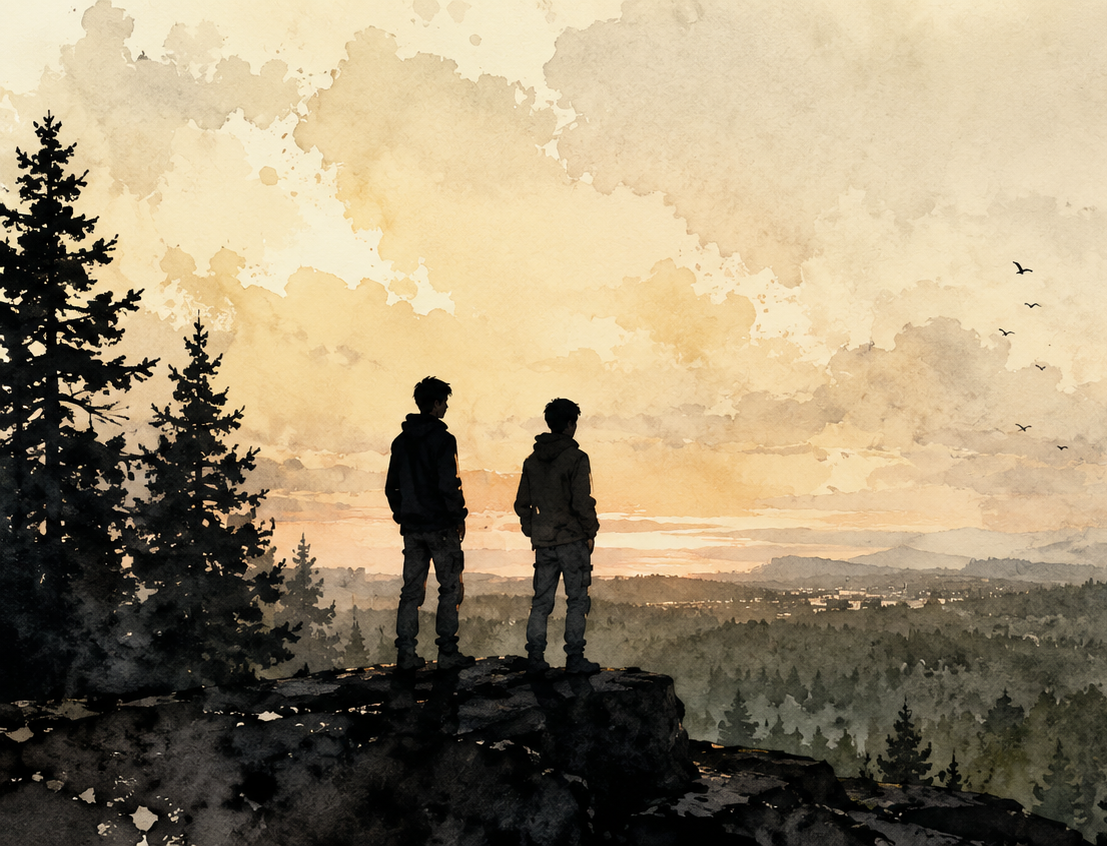
Every March 10th, Quentin and I played hooky to commemorate the finale of our favorite show, Mr. Radical and the Neptune Kids. The show had been cancelled for about five years, but we still maintained our own personal holiday, even though we had outgrown Mr. Radical and his band of otherworldly teenage sidekicks. We were in high school now. Our parents assumed our playing hooky on March 10th, many years ago, was a one-off.
We could not necessarily be seen in public – Quentin’s mom was a cashier at the FoodCorp, and my Dad worked at the hardware store. Both were owned by Proxima Industries. Everything in our town was owned by Proxima Industries.
It was Quentin who knew where to find the defunct conductor, and thus his suggestion turned into our mission for the day.
The conductor was buried deep in the forest. Its metal exterior was obscured by blankets of lichen and moss. Quentin went off path, scaled a boulder in that orangutan way we always did.
Quentin called from over the rock, “Conner! This way!”
“Maybe there is another way around,” I said.
All of our coordinating to maintain this ritual, to convince all appropriate parties we were where we needed to be…all of it would cease with a broken wrist.
“Doesn’t look like it,” Quentin called out from the other side of the rock.
I feared letting the silence between us linger to the point where Quentin himself would recognize his patience fading. I approached the rock and groped along its ridges for purchase. I heaved myself up steadily but with haste. I had a hard time making the final couple of feet. And there was Quentin just above me, hand out.
“Let’s go,” he said, seemingly not aware of my struggle.
I grabbed his hand, and he pulled me up. We walked onto the ridges, and the ascent up these boulders along the way was less arduous. Perhaps Quentin’s proximity gave me courage. He asked me about Melissa, a girl in our math class.
“You don’t have, like, a crush on her, do you?”
“No,” I said.
“You talk about her a lot.”
“Oh,” I said, thinking that perhaps Quentin knew more about these things than I did. He was learning a lot from the upperclassmen these days.
I asked Quentin if he liked anyone, and he shrugged. We climbed another boulder before he answered, “It doesn’t matter.”
We came across a clearing. From atop these hills, we could see the entire forest. To the northwest was our tiny town of Cog’s Hollow, six miles away. Everywhere else was a sea of green, a glistening shimmer of swaying trees underneath the morning sun. Black birds flew in the distance. In that moment, I knew that I loved Quentin. Not in a romantic way, but as a brother. I’ve always thought of him as such, but it was here, standing on top of the world, that I knew this moment to be impactful, even as I was living it. A sort of proto-nostalgia.
The quantum conductors poked into the sky, bigger than the mountains themselves. Kids in our class called them “upright cigarettes”. My dad called them “a middle finger to God”, although this was usually after he had a couple of drinks. A flock of birds orbited the structures. One of them collided with its semi-reflective exterior. It was far enough away that we only felt the thunk, not heard it. Animals always had a hard time with the conductors, we were told. Something about Earth’s magnetic poles.
We were told a lot of things.
The quantum conductors were as white as snow. The Proxima Industries logo wrapped around the entire structure. It was the color of ox blood and illuminated neon at night. It was difficult to see from my bedroom window, but the red incandescence was brutal from Quentin’s.
It was something almost awe-inspiring to see the quantum conductors in the sea of forest. The three structures poked into the sky, and I recalled the day when the Proxima Reps came to school to talk to each individual class. This was before Proxima Industries bought the land around Cog’s Hollow using something my dad called “Eminent Domain ”, which allowed the government to take land and homes away to help with some far-away war. My dad said that Proxima Industries was investigating the laws of the universe, that theoretically, if America could tap into the laws of quantum mechanics, it could harness the power of a black hole for infinite energy. Now wouldn’t that be something!
One of the reps said that we should never, ever get close to the conductors, and Carlos Martinez, the class clown, asked to define “close”. The rep snickered and said the conductors emitted so much heat and energy that they released a low and steady buzz, sort of like a bunch of beehives. If you could hear that, you’re too close. One time, Maggie Anaheim said that she was walking her dog Bandit and they got near a conductor by accident and Bandit went so nuts that Maggie needed to take him home, walk incomplete.
Neither Quentin nor I could hear the buzz from the techno-obelisks in front of us, and I spotted a deer at the other end of the clearing, sniffing at the reeds. A part of me wished that I had lied and told Quentin that I had not seen anything, that all the animals kept a wide berth like Bandit.
Quentin said, “You ever think you want to get out of here?”
“Cog’s Hollow?” I asked.
Quentin sat on the rock. “This place is so boring.”
“Yeah?” I said, thinking of some of the more rigid kids in our class. None of the cool kids talked to me like they did with Quentin. I wondered if this was Quentin’s way of saying that he was getting tired of their attention.
Quentin suddenly looked at me. “How did you know you liked Melissa?”
I shrugged. “I don’t really know if I like-like her.”
“Come on.”
“I guess I like how she smells. I like how she looks.”
“But why her and not another girl?”
“I think she’s funny and sweet,” I said. I liked talking about her.
Quentin opened his mouth and closed it again. I saw the gears in his head turning. Then he said, “Let’s get out of here and see what we came for.”
He turned to go, and I said, “You okay, Quentin?”
“Let’s go see the ruins,” he said, his voice armored. “It’ll be like the final episode of Mr. Radical, when they finally go back to the wreckage of the ship that brought him to Earth.”
He jumped down and vaulted with newfound energy. He was tall and spry, what our health classes would call an early growth spurt. A lot of kids in our class got early growth spurts. Already, some of the juniors and seniors were being scouted to play football or field hockey in college, full rides. Dad told me that Cog’s Hollow had one of the highest concentrations of Division 1 full athletic scholarships in the country, rivaling those of the town of Redding, Pennsylvania. Mom noted how peculiar it was that Proxima Industries had other quantum conductors there, too.
I was amazed at Quentin’s agility, his feline balance, the strength of his muscles. He reminded me of the Neptune Kids when they were imbued with the cosmic power from Mr. Radical himself. The story went that upon crashing to Earth, Mr. Radical split into five fragments, each one finding hosts in a ragtag group of kids. Their obvious variations of ethnicities – there was the Asian one, the black one, the British one – were on the nose. With each fragment of Mr. Radical’s power in the kids, they could do amazing things, like leap farther, lift more, hold their breath for hours. I wondered if this is what Quentin felt, in his new body, transitioning to adulthood. I doubt he even realized it.
Eventually, I made it to another clearing and stood by Quentin at the edge of the rock. The clearing looked as if a meteor had struck the top of the cliff. In its wake was about a football-sized field of nothing but overgrown weeds and grass. The cliffside crested at all angles, insulating us from the outside.
In the center of the clearing was the defunct quantum conductor, although it was miniature in scale, about the size of my house. It was almost comical compared to the large conductors we had just passed. Large reeds had taken it, and some parts of it were scabbed with rust. Unlike its eggshell white exteriors, this conductor was as black as onyx. The ox-blood red PROXIMA INDUSTRIES was faded by sunlight.
“How did you find this from where we were?” I asked, looking around and pushing some sepia-toned stalks aside.
“I could see it,” Quentin said. “Just look at it. Super cool.”
“But how did you see it, Quentin?” I asked. “We were down the mountain and deep in the forest, and this clearing is inset. It’s not like you could have glimpsed this through the trees.”
“It looks so weird being so tiny,” Quentin said, marching forward.
“Did you have a drone or something?” I asked.
“Would you believe me if I told you that I dreamt it was here?”
We approached the conductor, and even though I knew it was defunct because I could not feel the heat nor hear the persistent buzz, I was still cautious. Quentin was braver than I, and that meant he could be more stupid. He walked right up to it, placed his hands on the exterior, looking up at the large “R”.
“Why is this one black?” I asked.
“Maybe they turn black when they turn off?” Quentin said. “Or maybe this one is more special.”
We walked along the perimeter. The sun beat against us. I noticed that it would probably be around the fifth period now. I would be in math class with Melissa.
Quentin moved his fingertips across the black shell as if he were searching for some pressure plate. With a satisfying whoop, he said, “Got it, Conner!”
A sudden whooshing sound and the smooth exterior of the conductor opened into a small square that led into blackness. Quentin stood in front of it, as if presenting the finding.
“It’s like you knew where the button was,” I said, pushing through the overgrowth, careful to perk one ear to locate the low buzzing we were warned about.
Quentin was silent.
I said, “You did, didn’t you?”
“I had a feeling.”
Quentin and I looked into the abyss. I imagined it to be an unlimited expanse, full of wires and nuclear power and strange elements. No one knew what was on the inside of the quantum conductors. Jeremy Smalls said that his uncle worked on the robots that maintained the exterior of the conductors and said that the inside was a giant battery. Suzanne Gaintly, in Quentin’s history class, said her mom said that there was something large and organic in there, vials of proteins and amoebas. The thought made me shudder, to think of something monstrous trapped in the conductors. But one thing was for certain, the conductors occasionally exuded a milky, slightly pungent mist that carried odor down the hill. You could smell it on a breezy day, or sometimes after a rain. My house was closer to the town center, so I’m not as bothered. Everyone who lived nearer to the edge of Cog’s Hollow, like Quentin, often needed to shut their windows and put up air fresheners.
The inside of the defunct conductor was empty, a vast silo that extended as far downwards as the working conductors extended upwards. Quentin dropped a penny into the void. We waited ten, twenty, thirty seconds and still did not hear the impact of metal on metal.
“Waste of a wish,” he said.
“As if you could wish for anything,” I said.
One side of Quentin’s face was illuminated by the early afternoon sun, the other blackened almost entirely by the void in the conductor. “What do you mean?”
I must have irked him, because suddenly Quentin stood very erect. I doubt he realized. I said, “I’m just saying you got it made. You’re popular, you’re good at sports. You ace all your classes.”
Quentin shook his head, “Don’t you think you’re thinking too small?”
Before I could answer, he located a ladder and maneuvered his way down. I waited outside, listened to the breeze, and watched the wheat stalks sway. A flock of birds flew across the sky. In the distance, if I looked hard enough, the Proxima Quantum Conductors were visible behind the trees, bone white against the green.
Quentin called out, “Let’s go!”
I looked over the lip, down into the infinite blackness. The thought of the penny still dropping made me uncomfortable. I realized as I kept Quentin waiting that this was our entire relationship. Him waiting for me. Me waiting for me.
The ladder creaked under my weight but remained steady. A decade of rust and dust wafted up my nostrils. I speculated that the defunct conductor was still radioactive, like that nightmare in Chernobyl. I yelled my concern to Quentin, who by now had located a landing.
“It’s not radioactive,” he said flatly.
“You don’t know that.”
Quentin paused. “No. I don’t know. But I feel it.”
“I’m not getting cancer because of a gut feeling, Quentin.”
“Then don’t explore with me.”
I did not know what I did to deserve Quentin’s attitude. Since we left the house by way of sneaking through the forest of our respective bus stations, I’ve done nothing but follow him, always a pace behind. But today felt different. Had he mapped out this conductor before? When had he learned of its existence? I shamed myself into admitting I was jealous of a potential replacement, that Quentin might have found another friend to explore the wilderness outside of Cog’s Hollow.
Quentin was at the landing. Behind him was a long hallway with dimly lit bulbs, evidence of dying circuits.
“Does Proxima strip everything on the inside when a conductor becomes defunct? All the wires or the plasma or the…”
“Biomatter?” Quentin interjected. “Maybe. But it’s weird that they maintain the shells.”
“I wonder why this one was defunct in the first place.”
Quentin stopped and smiled. His being was aglow with the pulsing lights in the hallway. “Maybe we’ll find out.”
We came upon a clearing as large as a lake. This silo challenged my perceptions of space. Where did this conductor exist? Was it underground? A thought dawned on me that perhaps there were more quantum conductors underground, more than the ones I could see at the edge of town, from the schoolyard, from Quentin’s bedroom window. The gap gave me vertigo. I pictured large pulses of energy shooting out from a giant vat. Every twilight, the conductors released a minor electric pulse that the Proxima representatives called Benign Tremors. It felt like a sudden breeze, and the scent of burning wires dissipated as fast as it came. Sometimes, if you were closer to the conductors, you could feel the ground shake a little bit, as if you were standing atop gelatin. When the Proxima representatives spoke at the town hall, they handed out pamphlets with a whole bunch of explanations, but the last page was a pamphlet on what to expect with the Benign Tremors. Every once in a while, the fire alarm would go off, or the fridge would get too cold, or, if you were lucky, your alarm clock would reset itself. At the bottom of the pamphlet were directions to the bunker in the church, in the unlikely event of two tremors in succession. They did not explain what happened when there were two tremors.
Quentin was off again. There was another tunnel. It was hard to keep up with him. He was now almost speedwalking, unfettered by the absolute blackness beneath our feet. I tried to armor myself by faking Quentin’s confidence as my own.
I walked into Quentin’s back. He was in the middle of the bridge, hand up, almost like we were playing army and about to infiltrate a camp. There was a blue light glowing at the end of the tunnel. Quentin looked over his shoulder and raised a finger to his lips. We crept slowly to the other end and came upon a cavern no larger than my living room. It emitted an ephemeral, electric blue.
There were six kids, all more or less our age. They sat cross-legged, and they were naked. Two of them were girls, and they were beautiful in an abstract way, in which seeing nude breasts in art or on a statue was more aesthetically stimulating than sexually arousing. Still, my loins stirred when I saw their bare chests, and I kept my eyes away from all that I learned in health class, although I was curious. Their skin was pasty white, and their hair was the color of onyx. They sat cross-legged around a glowing blue orb.
None of the kids looked like any in our class, nor did they stir at our approach.
“Are they alive?” I whispered, feeling silly to ask such a question. I was still unconvinced that they weren’t statues.
“I think so. Maybe,” Quentin said. He perked up his head. “You don’t hear that?”
“Hear what?”
Quentin gestured around him. “It’s like there is an intercom or something. You seriously don’t hear that?”
I shook my head, trying to locate hidden words. “What does it say?”
Quentin snickered and looked into the orb from beyond the barrier of sitting children. His eyes were red with the onset of tears. He said, “That I’m loved, and it’s all going to be okay.”
“Who is saying that to you?”
Quentin wiped his eyes with the back of his wrist. “You wouldn’t get it.”
It was not immediate, and I doubt that Quentin fully internalized what he was trying to communicate. But I knew what he meant. Our paths would diverge. We would remain friends and be friendly, but I doubt that we would ever be best friends again. A sad thought engulfed me with the sobering acceptance that this would be our last time playing hooky. This was our final episode.
Quentin looked back at the kids. “They are not from here.”
“Let’s get out of here, Quentin.”
He smiled. “They are the Neptune Kids.”
“Come on,” I said.
Quentin looked at the naked children and their strange monk-like postures. They looked so peaceful.
“I don’t want to go back to Cog’s Hollow,” he said, and he was weeping again, although not in sadness. “I think I’ll stay right here.”
“Quentin, let’s go. We have to get back. Our parents will find out.”
“Parents are just constructs. Genetic transmitters. Their perceptions of the world are neutered in scope.”
“What?”
Quentin blinked. He looked at the children and eyed each of them. His shoulders slackened. Something clicked in him. He found whatever he was looking for. After a long pause, he agreed to return to the surface, and we traveled our way back in silence. Occasionally, Quentin would say I know and I love you, too and when I would look over my shoulder to confirm he was talking, he would simply shrug. After the third time, he snapped at me to stop asking, and by the fourth time, I ignored him completely.
The sky was a light orange.
“Quite the adventure,” I said, trying to distract Quentin from the silence.
“It’s like that episode where Mr. Radical saves the Neptune Kids from the Mole Men of Mars. When all the kids were blinking in the new light and disoriented,” Quentin said.
I laughed to hide my discomfort from Quentin’s morosity. We managed to leave the crater, and both he and I gave one long, hard look at the white quantum conductors lording over the forest which surrounded our innocuous town.
I said, “I think I’m going to ask Melissa to be my girlfriend.”
“I think she’ll say yes.”
“You never told me who you like.”
Quentin said, “One of the seniors.”
I listed the senior girls.
Quentin shook his head. “No. Not them. Joe.”
“I just said Joanne Clint.”
She was one of the cheerleaders. Everyone with a beating pulse liked her.
“No. Joe.”
I stopped only briefly. There was only one “other” Joe that fit the description. A wallflower that smoked outside of Proxima Convenience. “Oh! Oh.”
But Quentin kept walking, nonplussed by this admission. I hustled to keep pace.
We left the forest just as the street lights went on. The Proxima Quantum Conductors were visible in the distance, stark against the darkening sky, the giant “R” logo illuminating like some giant, glowing tattoo. A subtle pulse underneath our feet signified the 6:00 pm Benign Tremor. We came to the crossroads of Albert and Marle.
“Let’s do something different next time,” I said. "Next year we’ll have our learner’s permit, and maybe we can go to an amusement park.”
“Sounds great,” Quentin said.
I could see in his eyes that he was already planning on returning to the defunct conductor the next chance he got. He knew better than to ask me. I knew better than to ask him. This would be his secret place, a place I had only been able to visit just the one time.
“See you tomorrow?” I asked.
“You bet.”
We bopped our fists together. Before turning the corner again, I caught a glimpse of Quentin. He was staring back at me from the other end of the block. We waved to one another and went our separate ways.