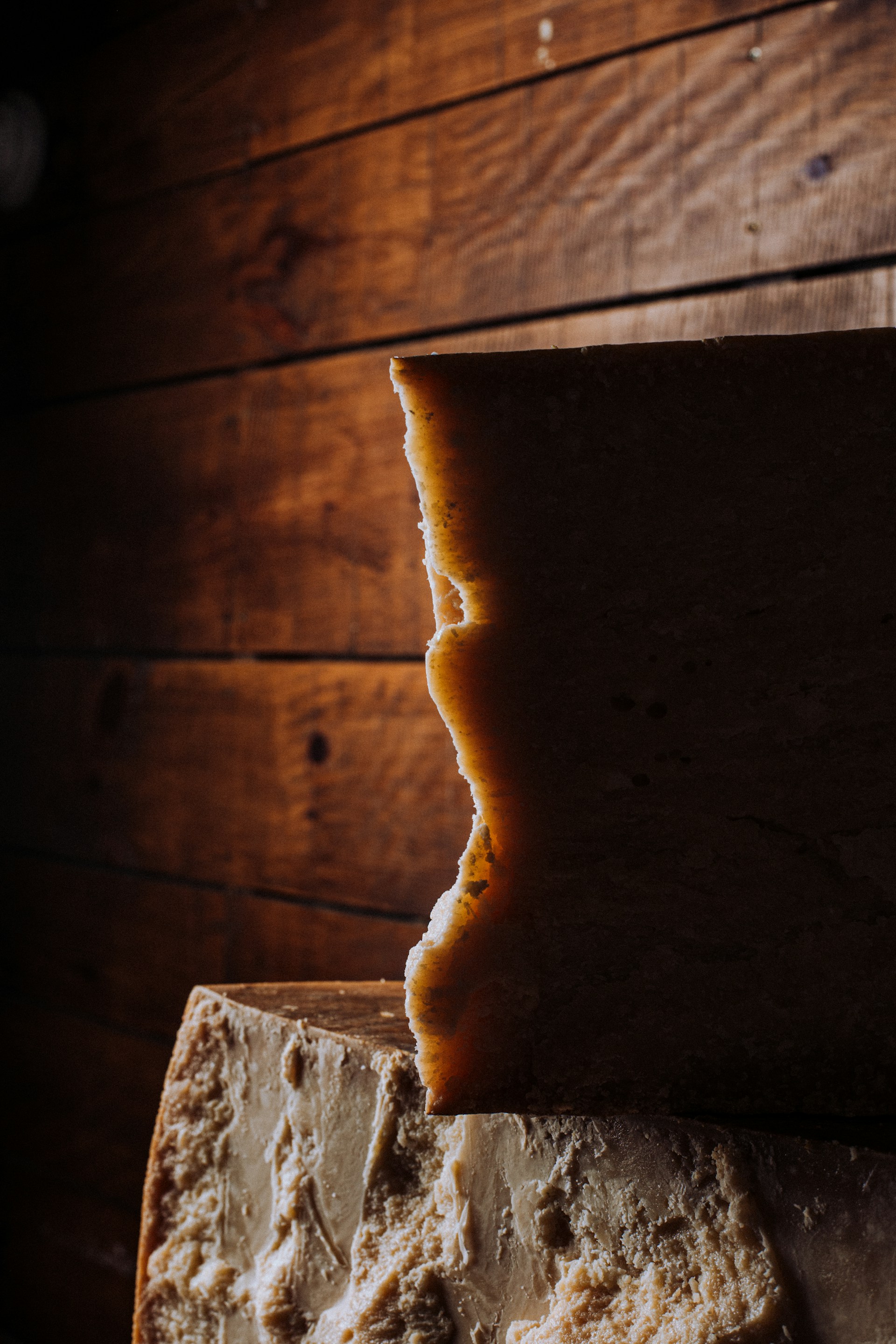
She wanted cheese.
She wanted a subtle, nutty gruyere; an aged, elegant comte; an oozing, generous brie sweet with honey and apples. She wanted roquefort and reblochon, mozzarella and gorgonzola, cantal and cotija, and cream cheese. She wanted bleu d’Auvergne, Tomme de Savoie, Crottin de Chevignol, French cheese, but not just—all of it, from everywhere, even the cheeses she’d grown up with: sharp curls of white Vermont white cheddar, grilled Kraft singles melting helplessly into sizzling meat.
Even the funkiest, nastiest, she craved: the moldiest blues, the stinking chunks of Maroilles that Lillois dunked in their coffee. The rotting, horrible ones from Corsica and Sardinia, with maggots wriggling in them, made her drool. She craved that delicious decay, the taste of destruction. In her fantasies, she flung herself face-down on a raft of feta, clawing and gnawing as it crumbled beneath her, and, when there was not one single tangy, creamy curdle left, drowning happily in the sea of brine.
There was cheese everywhere; she lived in Paris. That evening in late November when she emerged muffled in a scarf, there was a big Savoyarde in a wool cap on her corner stirring a massive iron cauldron of tartiflette with potatoes and onion drowned in gooey Reblochon and cream, the whole thing steaming irresistibly. She could not taste it, she told herself, but she could still look.
A faux Swiss chalet had been erected in the market square of Edgar Quinet. It was a pop-up raclette restaurant for cheese season, the time of year when Parisians dressed in apres-ski clothes and dreamed of fresh mountain air and hearty food, the hardest time of the year for her. She pressed up against the thick plastic curtains of the entrance, watching six laughing girls lean towards the hot metal machine which was plugged into a buzzing generator. When the sliced red peppers sizzled on the grill top, she sizzled, too, and when a metal fork sliced into the white, powdery flesh of a crisp-skinned potato, a hot puff of longing from her mouth fogged the curtain.
But she hurried to scrub the blur away. She didn’t want to miss the grand moment, the perfectly calculated climax of French winter cuisine: the metal scoop drawn slowly from the machine to reveal a gooey golden lake, bubbling with heat, flecked with wild garlic, crowned with a crisp brown patch of irresistible caramelization.
She could already taste it. She would have poured it, scorched and bubbling, straight from the sizzling metal shovel into her mouth. She would have torn the plastic curtains open, dashed inside, and flung herself at the flames of the raclette machine like diving recklessly into a volcano. But it was the volcano that was the problem…
But this was raclette! Raclette couldn’t be so bad! Raclette was hearty, mountain food. If she ate slowly, and took a long walk afterwards… And the wine! Of course! The right bottle was there on the table, a sweet white Gewürztraminer from Alsace. The sweetness balancing the richness of the cheese, the wild garlic picked out with each sip, and not a drop of water. You never drank water with raclette; everyone knew that. If you did, all the cheese clumped into a heavy ball in your stomach. But with wine….
French people could do it. Others could chance it. She, however, couldn’t take the risk. Raclette was far too rich.
Turning her back on the chalet, she crossed the square towards the Rue de Montparnasse. Looking was not enough, and raclette would be too much. But a taste… A single slice of cantal, carved so closely from the white wheel that the edges feathered and fell to bits in her palm, melting like snowflakes as she hoovered it from her skin. A cube. A crumb. A mere morsel, just one to satiate her, and after that she could think about something else.
A dozen little fromageries with green-and-white awnings dotted any street in Paris, and the one on Rue du Montparnasse was particularly old, with the names of the cheeses in the window handwritten in spidery script. A strange bell tinkled overhead as she entered the wood-paneled shop, where a fromagere in a white coat like a doctor’s was wrapping an enormous wheel of tomme de chevre like a Christmas gift. Carefully sealing the wax paper at the exact center with a green sticker, she labeled it in swirling, beautiful loops with a fountain pen, then looked up.
« Est-ce que je peux vous aider à trouver votre bonheur? »
That peculiar French shopkeeper phrase: May I help you find your happiness?
She meant to answer, Just one slice of Cantal, please. Very thin. Or maybe, is that your smallest piece of Roquefort?
Instead, she blurted out, in French, what she was really thinking:
“I want everything.”
The fromagere had very white hair that matched her white coat and very thick lenses that magnified her strange eyes double.
“Everything?” She studied Laura’s face. “Are you sure? Because you see, I can help you…”
She came out from behind the wood-paneled counter and began to advance towards Laura. Laura backtracked, holding up her cold, white-blue hands.
“No, no. I mean, first of all, I couldn’t afford…”
It was true; the Bleu de Termignon alone was 45.29 per kilogram, and the wheels of Beaufort could run you several hundred. But it wasn’t just the price. It was her shame: she was lactose intolerant.
Not just lactose intolerantsuddenly, violently, irrevocably lactose intolerant. The very week she’d arrived in this paradise of cheese, it had begun: first, sharp pangs in her belly, like knives, then a dash to the bathroom, where hot lava burned through her body. When it was over, she had crumpled to the cold tile, weak and shaking.
French people usually reacted with pity and contempt: “I’m glad it’s not me.” Or pompous disbelief: “But not FRENCH cheese. OUR cheese is artisanal, produced with the best local ingredients and the artisanal savoir-faire of five centuries. That processed American plastic shit made you sick, not ourswhy don’t you try it?”
But she had tried it, and it had ended in agony, with daggers in her stomach. She had come to Paris for a life of pleasure; she could not have it.
But the fromagere did not react as she had expected. She actually smiled, and Paris shopkeepers rarely smiled.
“I may have something to help you.”
Laura shook her head woefully, inhaling the salty, creamy aroma of all she could not have, dizzy with wanting. She had tried the pills, the drops, the supplements.
But the fromagere had her back turned, unfolding a creaky ladder and climbing to the top wooden shelf, where she drew a smaller and older bottle from behind the champagne. When she handed it to Laura with two hands, Laura blew the dust off the label.
It was in a language she didn’t recognize, and the liquid glowed gold through the glass. It had to be something even sweeter, even stronger than Gewürztraminer, from a rare mountain region where lactose-intolerant goatheards managed to live exclusively on cheese by getting stupendously drunk on this dangerously alcoholic concoction. Ancient mead from local bees, maybe, or an eau de vie from a medieval cellar.
“Is this language Basque?” Laura asked.
“No,” the fromagere replied calmly. “It is magic.”
She really was dizzy. Obviously, she was hallucinating because she was hungry. There were other things to eat in Paris: potatoes sauteed in goose fat, duck confit packed in salt. She would go eat a real meal, and after that, she would be able to think more clearly.
But the fromagere continued, just as calmly: “Do you know alchemy?”
“I…”
Nicholas Flamel, who had lived in a stone house in Le Marais. Magic. Changing things into other things.
“If you drink this,” the fromagere promised, and winked as she recalled Laura’s own words back to her, “You will be able to eat everything.”
The gold liquid darkened to amber when Laura turned the bottle away from the light. Alchemy. A sick and homesick American into a glamorous French glutton. A secret potion in a language she didn’t speak, to make her one of them.
She hesitated only as long as it took to inhale.
She paid 49 Euros plus TVA for the bottle. The fromagere wrapped it in green wax paper, sealed it with a sticker, and wrote a word of warning in spidery script that Laura decided not to read, even though it was in French.
And then she set out to eat cheese.
The café on her corner was perfect. They had simple but delicious cheese plates, friendly staff, and clean toilets. Settling into the table closest to one, she asked for the petit assiette de fromage, plus an extra glass.
The liquid gleamed an incredible gold in the winter sunlight through the window. She had filled the small water glass a quarter full, and she decided to take it like a shot, raising the glass, thinking, Here goes nothing, and tipping the whole thing back.
The liquid burned like whiskey and sparkled like Pop-Rocks. She swallowed three times and could still feel it warm down through her sternum and taste the sweet, almost syrupy liquid in her mouth. She waited a full minute, then took her first bite.
It was Saint-Nectaire, a mild cheese from the Auvergne with a texture like brie. She cut just the very tip of the wedge, a piece the size of her pinky nail, and chewed the soft, ash-dusted skin carefully. Then she swallowed.
Nothing. Her stomach did not gurgle. No cramps. But of course, it took time to digest. The stabbing pain always came at the end of the meal. She would be smart to take things slowly.
She didn’t.
At first, she tried to eat decorously, tearing neat bits of bread, nibbling the cornichons and lettuce that dressed the plate. But the small bite of cheese had ignited her appetite, filled her mouth with the taste she had craved for months, until drool ran down her chin. Soon the next cheese was gone, and the next—she was not cutting the careful wedges and rectangles that French etiquette dictated, but sawing off rough chunks, shoving them into her mouth, still chewing and swallowing as she went back for more. The cantal was gone, gnawed to the croute, and the more pungent Laguiole. Soon, the blue cheese stood alone.
It was a bleu d’Auvergne, crumbling at the edges, sweating a bit now, the blue veins pulsing with life. Laura paused, breathless from stuffing her face, sure some punishment would come for her gluttony. But her stomach felt calm; the golden liquid lined it with a warm glow that embraced each new cheese as it came, welcomed it for the nourishment it brought, and honored the savoir-faire of the generations of French farmers who had created it by letting it rest easily in her digestive system. She did not so much as burp.
So, seizing the blue cheese, she shoved it in her mouth like a Pop-Tart, gnawing deep grooves into the tangy, creamy surface, swirling salt in her saliva, nearly choking, her cheeks like a chipmunk’s, tears in her eyes.
The waiter behind the bar looked over in alarm, ready to clap her on the back, but she smiled and gave him a thumbs up, because the mold was so good—a rich and wondroustaste of decay that lingered even as she swallowed again and again.
“Ca etait?” he asked when he came over for the plate, his kind bald head like sweating mozzarella.
She cleared her throat, sure it would be thickly coated and choked with cream, but surprisingly, when she said, “Tres bien, merci,” her voice rang out clear as a bell.
Everything, in fact, was clear. The golden glow had illuminated the café, too, and everything was sharply outlined and full of color. Maybe it was vitamin absorptionthe phosphorus she’d been missing all this time, the way she’d lacked Vitamin D last winter. She felt a surge of love and desire for everything around her, and after leaving a large and unnecessary tip, she rushed outside without her scarf to embrace Paris.
Paris! The stones lining the doorways looked just like the ashy pyramids of Valencay in the cheese shop window, and the cobblestones like pebbled rounds of chevre to her now. They even felt differently under her feet—spongier, yielding. But of course, she was probably drunk. That golden liquid had probably been eau de vie, the wildly boozy apple liquor that her friend’s Norman grandfather made in his claw-foot tub. That’s what was making her ditzy—so ditzy that she actually bent down to see if the cobblestone was goat cheese.
It was. A cobblestone with a firm, round pebbled skin that she scraped away with her fingernail to reveal the creamy white underneath, thick and smeared, the briny smell of it rising to her nostrils. She scooped it with her index finger, brought it to her tongue, licked it off, and swallowed the pungent salty cream.
So someone had been silly enough to drop goat cheese on the cobblestones—very silly, what with the price of a good Pouligny-Saint-Pierre these days. And she had been silly enough to eat it, which maybe wasn’t so silly with the price of a good Pouligny-Saint-Pierre these days, but the other cobblestones had to be cobblestones.
Didn’t they?
Except the next one wasn’t, and the one after that, either. She scraped the skins off all of them and plunged her fingers in. They were all goat cheese, and the gray slate curb of the building that looked like Valencay was Valencay.
Goat cheese made her sicker even than cow cheese, and Valencay was goat cheese, too, so she shouldn’t have more, not when she’d already devoured seven cobblestones. But she was not sick, and she was not full. She was hungry. She lay down on the cobblestones, smearing cream all over her wool coat, and turned her head to take a great chomp of the curb. It was earthy and rich, like eating mushrooms right from the ground in the forest. Maybe it had grown here. Good goat cheese, from the earth, given by nature. It was meant to nourish her.
And if it wasn’t… did she care? What else could she do now, sprawled, gnawing on the ground, then confess it? She had always been hungry, and she had always been bad. In church, she used to bend her head and pretend to pray when she was really licking the pews. She would slather on the fragile pages of the hymnal and rip corners that melted on her tongue quicker than Communion wafers. She’d eaten all of Psalm 78.
And now she was going to chew cruelly through the curb like a termite, savoring the peppery aftertaste of the Valencay and the mineral sting of its skin. When the building collapsed, she would roll in the ruins like catnip. What bad had ever happened before or yet? She would not stop at the great blocked cheddar fortress of the Louvre, the fat camembert that was the Bourse de Commerce. The high white basilica up on the hill, she would pluck like a mozzarella ball and pop in her mouth, and then she would devour on, all of it: apartments, bridges, cars and fruit carts, the tobacco stand on the corner, the bent stop sign and the flower boxes….
People.
They had been passing, smiling oddly indulgent smiles at her, sprawled and gnawing and destroying their sidewalk, when usually French people glared if you laughed too loud or turned a baguette upside down. But now she really saw them: the older man, pockmarked as a six-month Manchego, the young girl, smooth as a triple-cream brie, the long, thin librarian she could peel like string cheese. And the baby! The fat burrata baby bubbling with laughter in a raincoat like a plastic bag. Oh God…
She had to get away. Digging her elbows into the chewed cobblestones, she army-crawled forward, schmearing her belly like a bagel on the creamy ground. She couldn’t stand, and she couldn’t stop eating. It was her own pathway she was gnawing out, her own escape she was destroying, and the People were really after her now. Clammy hands closed on her ankles. Strong arms dragged her backwards. She dug her nails into the pebbled skin and tore long scratches of resistance, but somehow in the struggle, her forearm scraped a rougher patch of real pavement and split open, bleeding.
It wasn’t blood. It was black cherry jam, the kind she bought jars and jars of in the Basque country, sucked the Itxassou cherries out of. She sucked at her split skin, digging her elbows in to hold her ground. It wasn’t blood, but she had sucked her own blood this way, squeezing paper cuts, picking and biting her scabs. And her skin wasn’t her skin but the creamy, golden-rined sheep cheese they served the jam with, salty and sweet, the one she’d chosen a dozen times over crème brulee or chocolate cake because she could not resist it. She licked and sucked and bit, sinking her teeth into skin which was hers and wasn’t, creamy and salty and rich. She was destroying herself—she didn’t care—she was hungry, and the hunger buzzed like wasps around her head, greedy angry bees, swarming and stinging, biting and burrowing, and she dug in her fiercest vampire incisors until there was a great yawning dark hole in her arm.
The hands locked on her ankles again; she struggled forward still on her chest, because the dark and delicious hole in her arm had come alive with maggots. Maggots! White worms flushed pink and alive, ringed and filled to bursting with something she wanted, wanted. Wriggling irresistibly, tempting her to bite and feel them explode with blood in her mouth. One final vicious kick freed her legs, and gnashing her teeth, she pitched herself forward at the same time, towards the rich dark wound open in her skin.
But she had devoured more than she knew. The hole in her arm was gnawed all the way through, to the great yawning gap in the sidewalk, to the tunnel deep into the earth where the graves rotted, to a black hole in the universe. And when she tipped forward into it, she found herself falling, falling, falling, her legs tumbling over her head, the blackness up and down and all around her, the maggots dizzying confetti she could not capture as she somersaulted and somersaulted, sick to her stomach at last.
She woke up in her own bed.
The air was dry and linenny, stale and tasteless. The mattress springs creaked under her. The wooden floor under her bare feet was splintery and solid. Dust bunnies brushed her toes as she padded across the hallway to the cold tile of the kitchen.
The fridge was humming a single droning hum in the dark, doing its duty. The blinding white and clean inside when she knelt to open the door was like a sanitized hospital morgue, wiped spotless glass, and the food wrapped in saran wrap inside sealed plastic boxes, impossible. She was in her civilized pajamas, and she was not drooling.
But when she unclipped the plastic lid and the first odor of parmesan rose, some feral raccoon instinct rose in her. She grew claws, tearing at the saran wrap, shredding the neat triangle of Parmesan until the gritty crystals were digging in under her nails and chewing them out, gnawing the rind to jagged edges until the pains came. The aged and fetid stink was in her nostrils, and the nutty salted taste was in her spit, but the grit and the tang, the bite and the umami, she did not savor like she savored the knives in her greedy, greedy stomach.