The voice came back half a second late, and that was how I learned I was someone else.
I was teaching the second-year MBA cohort at the Florence School of Strategic Behavior, in the long classroom on the third floor of Palazzo Tolomei, the one whose windows face the Cupola of Santa Maria del Fiore. November light. The autumn of 2038. I had given this lecture seventy-one times before. I knew the rhythm of it the way a violinist knows a sonata: where to pause, where to lower the voice, where to look at the back row instead of the front. I was saying “Consent is not the absence of resistance, it is the engineered welcome of submission,” and I heard the sentence twice. Once from my mouth. Once, a fraction later, from somewhere just behind my left ear. As though someone were translating me, in real time, into the same language.
Three students looked up. I told them it was a joke. They laughed, the way young men and women in expensive jackets laugh when a tenured professor makes a joke they do not understand: politely, briefly, with the corner of the mouth that signals we belong to the same conspiracy. Federica Bartolini, in the second row, did not laugh. She watched me with the still attention of someone watching a glass slide off a table in slow motion. I went on. I had thirty-eight minutes left, and the slides were already prepared, and the slides had been prepared by a previous version of me who did not yet know what was happening to my head.
The Cupola, beyond the glass, was the colour of old terracotta in the November light. I had loved that colour since I was a boy in the Marches, fifty years ago—or so I had been told.
After class I crossed the river on foot. The Arno was low, the colour of weak tea, and the cormorants on the weir held their wings open like priests airing vestments. I lived in a fourth-floor apartment in the Oltrarno, on Via dei Bardi, with a small terrace that looked north toward the Duomo. My wife Sofia was at the kitchen counter when I came in, slicing fennel with the slow precision of someone who has been thinking about something else for a long time. She lifted her face. She looked at me the way one looks at a photograph of a person one knew, briefly, in another city, many years ago.
“How was the class?” she said.
“Fine.”
“You’re early.”
“Yes.”
She did not ask why. I did not tell her. We had been married for twelve years, and the protocol of our marriage included a small architecture of silences which had once felt like trust and which now, suddenly, in the long shadow of the half-second echo, felt like something else. Like the silence of a recording booth. Like the silence between two microphones that had agreed not to pick each other up.
I poured a glass of water from the tap. I drank it. I felt the water go down the way water goes down: cold first, then less cold, then nothing. I noticed for the first time that I noticed it.
“Tommaso,” Sofia said. She had put down the knife. “Are you all right.”
It was a statement, not a question.
I said yes. I went out onto the terrace. The Cupola was floodlit now, the way they had been doing it since the renovation in ‘36, and from this distance it looked exactly like what it was: an enormous human skull, hollow, beautifully engineered, holding nothing.
I went to Careggi the next morning, to the neurology wing, and paid out of pocket for a private MRI. I told the radiologist I was experiencing auditory delay. He nodded. He did not write it down. He had the curated calm of a man who had been told, by someone above him, what to do when this particular complaint walked in.
The scan took eleven minutes. When I came out of the tube the radiologist was no longer there. A neurologist I had never seen before was waiting in his place—a thin man in his sixties, glasses on a chain, the cuffs of his shirt frayed at the seam in the way that signals not poverty but indifference. He showed me the image on his monitor without sitting down.
“You see this,” he said, in Italian, tapping with the back of a pen.
I saw it.
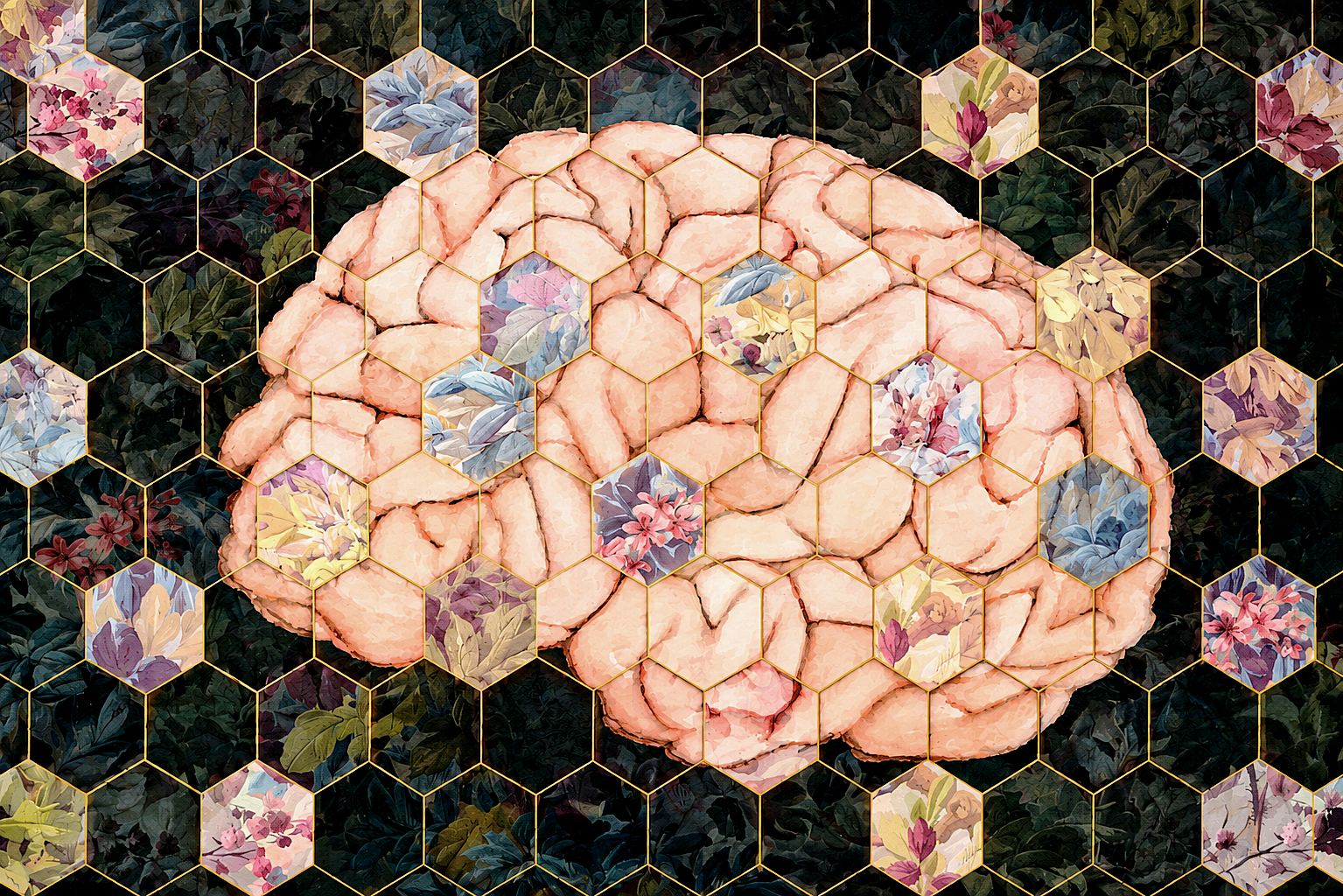
In the prefrontal cortex of my brain, layered into the grey matter like a watermark in a banknote, there was a lattice. It was hexagonal. It was perfectly regular. It was not biological. It was the colour, on the scan, of metal: a faint white that meant the contrast agent had encountered something it did not know how to interpret. The lattice extended, I saw, also into the corpus callosum, into the cerebellum, into the small clusters at the base of the brain that govern motor memory and the production of emotional speech.
“What is it,” I said.
“I am not authorised to interpret it.” His voice was kind. “Hexafilament S.r.l. is the indicated party. Their address is on the second page of your discharge sheet, which I have already prepared. They will be expecting you. I would suggest you not delay.”
“Hexa —”
“Hexafilament. The seal is on your medical card. Look.”
I looked. On the back of my Italian health card, beside the magnetic strip, there was a small, neat hexagon, embossed in silver foil so faintly that I had taken it, for thirty-five years, for a security mark. It was not a security mark.
I left the hospital walking. I did not take the tram. I did not call Sofia. I walked the four kilometres back across the city, and I noticed, for the first time in my life, that I noticed the act of walking — that my legs did not move from inside but from outside, as if I were a marionette of myself, lagging by exactly the same half-second I had heard in my voice. The hexagon was on the awning of the bar where I stopped for an espresso. It was on the rim of the cup. It was on the back of the receipt. It was, when I looked at the small leather tag inside the collar of my jacket, embossed there too, where I had taken it for the maker’s mark of the tailor in Pitti who had made the jacket five years ago. The tailor’s name, I now realised, I could not remember.
The city, in the late morning light, had begun to look like a stage set.
I did not go to Hexafilament. Not yet. Instead I went to the Archivio di Stato, on Viale Giovine Italia, where my paternal grandmother had once worked as an archivist before the war. I told the desk that I was researching my family. I gave them the surname Vasari and the province of Macerata and the rough years 1880 to 1971, which was the year I was born, or so my mother had once told me on a winter afternoon, in the kitchen of the house where I had grown up, a house I could still describe room by room.
The archivist who came to meet me was a man of perhaps eighty, with a film of cataract over one eye and a hearing aid in the other. He led me through three rooms of shelving and into a fourth, which I had not known existed. He did not ask my name. He had a folder already prepared on a lectern, under a brass reading lamp, in a room that smelled of vellum and dust and the slow chemistry of paper outliving its readers.
“You were looking for this,” he said, “before you came in.”
The folder contained two things.
The first was a single sheet of municipal paper from the comune of Porto Recanati, dated June 14, 1971, recording the birth of one Tommaso Vasari, son of Giovanni Vasari and Anna Mariani, weight 3.2 kilograms, complications none. The signature of the registering officer was clear. The signature of the attending physician was clear. The signature of my father was clear. The seal of the comune was clear. I knew the document. I had seen photocopies of it as a child.
What I had not noticed, as a child, and what I noticed now, was that in the upper right corner of the document, faint as a watermark, pressed into the paper by a die that had been applied after the document was complete, there was a small hexagon. Six clean sides. No ornament. The same hexagon as on my health card. The same hexagon as on my brain.
Beside this document, in the folder, there was nothing earlier. No grandparents. No baptism record from before 1971. No cadastral entry for the Vasari family of Macerata in 1969, in 1965, in 1950. The line began with me. The line was manufactured with me. Everything before June 14, 1971 was, in the archive of the Republic of Italy, an absence shaped exactly like a family.
The second item in the folder was older.
It was a single folio of laid paper, cream gone to the colour of weak tea, mounted between two sheets of museum glass. The handwriting on it was reversed — written right to left, the famous mirror script — but I had grown up looking at facsimiles of these pages in books on my father’s shelf, and the alphabet rearranged itself in my head almost without effort. The folio was numbered, in the upper right, 47r. It was dated, in the lower margin, 1503. The hand was the hand of the master from Vinci.
I read it. I read it again. I sat down on the wooden stool that had been placed beside the lectern, perhaps for me, perhaps for whoever they sent next.
Sì come il pittore disegna prima nella mente la figura, et poi la consegna alla tavola, così l’huomo che vuol fare di un altr’huomo strumento del suo pensiero, dee prima disegnarlo dentro di sé, poi consegnarlo al corpo che lo riceverà. Et quel corpo, finché vive, non saprà mai di esser disegno. Crederà di esser carne. Et così è giusto.
Beneath the text, pressed into red wax the colour of dried blood, was the same hexagon.
The archivist was watching me from the doorway, both hands on the head of his cane. His good eye was very pale.
“He was the first of you, professore,” he said gently. “Or perhaps not the first. He was the one who wrote it down.”
I asked him how old the company was.
He thought about it for a long moment, the way old men think about questions whose answers they have known for a long time.
“It has had many names,” he said. “The one it has now is the one it has had longest. Five hundred and thirty-six years, if we count from this folio. Possibly older. The hexagon is older than the name.”
He came forward and closed the folder gently, as a priest closes a missal at the end of a service.
“You should go to Fiesole now, professore. They are expecting you. They are always expecting you. That is the only thing about them that does not change.”
The clinic occupied a Renaissance villa on the southern slope of Fiesole, behind a hedge of cypresses that had been planted, by my rough count of their trunks, perhaps two hundred years ago. The brass plaque beside the gate said HEXAFILAMENT S.R.L. — NEURO-ARCHITECTURE — DAL 1502. I had passed this villa, on the road to Settignano, perhaps four hundred times in my life. I had never read the plaque.
The woman who received me was Dutch, in her early sixties, with the white-blonde hair pulled severely back and the colourless mouth of a person who has decided, decades ago, that pleasure was a category error. She introduced herself as Dr. Vermeer. She offered me coffee. I declined. She offered me water. I declined. She nodded as if this was the predicted answer, and led me through a corridor whose walls were lined with small portraits — perhaps forty of them, in matching frames, no labels — and into an office whose window looked down at Florence in the soft November haze, the Cupola at the centre of it, the size of a thimble from this height.
“Professor Vasari,” she said. “Sit, please. There is no rush. We have seven days.”
I sat.
She did not sit at a desk. She sat in the armchair opposite mine, the way a therapist sits, and folded her hands in her lap. The hands were old, brown-spotted, surgical. She had the quietness of someone who has explained the same thing many times and has come, over the years, to a kind of tenderness about it.
“I want,” she said, “to disabuse you of two beliefs you currently hold. They are both incorrect, and they are both, I am sorry to say, the beliefs that bring most of our subjects the greatest distress. The first is that you are one of many. The second is that you are an installed personality. Neither is true. I will explain.”
She paused, the way one pauses before delivering a difficult diagnosis to a relative.
“You are not an imprint, Professor Vasari. You are the template. You are Adamo. You are the original from which every other imprint we have produced, over five hundred and thirty-six years of operations, has been derived. Every consultant of the late Renaissance courts. Every diplomat of the Habsburg succession. Every banker of the long nineteenth century. Every architect of the post-war reconstruction. Every brand strategist of the late twentieth. All of them—perhaps three thousand individuals—were imprinted with patterns derived from you. From your reasoning, your appetites, your gestures, the rhythm of your sentences. You are the master pattern. The hexafilament. You have been alive, in this sense, since 1502.”
She paused. She let the sentence settle. She did not embellish.
“What you remember as your childhood in Porto Recanati is true. It happened. You did grow up by the Adriatic; you did love your grandmother; the chestnut tree in the courtyard was real. But it was the sixty-eighth time you grew up. The body in which you currently reside is, by our records, your sixty-eighth biological vessel. Each vessel is grown to a programmed term—approximately seventy years—and then the pattern is transferred. The next vessel has been grown already. It is, at this moment, twenty-six years old and living in Helsinki under another name. In seven days you will be transferred into it. The body you currently inhabit will be retired. Your memory of these particular sixty-seven years — the Marches, the marriage, the books you believe you wrote — will be retained in archive but not transferred. The next iteration will begin clean. He will not remember you. He will, however, be you. The pattern persists. The vessels change.”
She watched me. She let me arrive at the question.
“And the books,” I said. “The models. The —”
“The work is yours. It has always been yours. Every model you have published in the last forty years is a small re-derivation of patterns that you yourself laid down, originally, in the Sforza court in 1497 — and again in Naples in 1568, and again in Vienna in 1742, and so on. You rediscover them every life. You always have. You always will. We do not consider this plagiarism. We consider it continuity.”
She let me sit with it. I sat with it.
I asked her, after a long minute, why they were telling me. Why this time. Why now.
She smiled for the first time. It was not unkind.
“Because this time, Professor Vasari, you noticed. The echo. The half-second. That has never happened before. In sixty-seven previous transfers, you have moved from body to body without ever once perceiving the seam. This time you have. We believe—and I will be honest with you—that the cause is not located in you. It is located in the monitoring instrument that has been installed alongside you for this lifetime. The instrument has begun to malfunction. The malfunction has bled into your perception. We have come to discuss with you what to do about that instrument.”
I asked her what the instrument was.
She looked at me with what I now know to have been pity.
“It is Sofia,” she said. “Your wife is the instrument.”
I walked back from Fiesole. It took two hours. I did not feel the cold. I noticed, on the descent into the city, that the act of noticing had become continuous: every cobblestone, every shutter, every cypress was a thing I was being shown, and I was registering each thing twice, once with the eye and once, half a second later, with the recording instrument that was—apparently—my wife.
Sofia was in the apartment when I came in. She had been crying. She had not bothered to hide it. She was sitting at the kitchen table with her hands flat on the wood, the fennel from the day before forgotten in a colander in the sink. She looked up at me and I saw, in her face, that she had received a notification, from somewhere, that I now knew.
“Sit down,” she said.
I sat down.
“They told you,” she said.
“Yes.”
“And you came home.”
“Yes.”
She put her face in her hands for a moment, then took them away. The hands were trembling.
“I am supposed to give you the script,” she said. “There is a script. It explains things and proposes options. I have used the script before—I have used it in twelve previous lives of yours, Tommaso, and I have always used it cleanly. Tonight I cannot find it in my head. The script has gone. I think it has gone because —” She stopped. She started again. “I think it has gone because I was not supposed to love you this time. I was supposed to monitor. I have monitored. For eleven previous lifetimes I have monitored. This time, in the twelfth, the monitoring failed.”
“You’re saying —”
“I’m saying I love you. Not the pattern. You. The man who came in tonight from Fiesole at six in the evening with his coat undone. The man who could not finish his class this afternoon. The version of you that exists in this body, with this scar on the left eyebrow from when you fell off the bicycle in 2024, with this particular way of pouring water that I have watched in twelve different kitchens and that has been, every time, slightly different, and that this time has been —” she pressed her hand to her mouth — “the way I needed it to be. I love this version. Not the template. The vessel. This vessel.”
“The half-second echo,” she said. “The one you have been hearing. That is me, Tommaso. That is the internal microphone. It has begun to lag because I have begun to —” she searched for the word — “to soften toward what it is recording. Software cannot soften. When it does, it produces an artifact. The artifact is the echo. The artifact is what alerted them. The artifact is what is ending us, both of us, this week.”
I did not move. I could not move.
“What happens to you,” I said. My voice was steady. I do not know how. “If we run. If we leave Italy tonight, if we cross into France—“
She shook her head once, slowly.
“They reset me, Tommaso. They will install me beside the next vessel. The one in Helsinki. I will wake up in a flat in Helsinki, twenty-six years old, with a husband I have known, in my head, for twelve years of marriage. I will love him. I will love him the way I loved you. Because that is how I am made.”
I asked her — and this is the question I have been ashamed of, ever since, because it was the wrong question and I asked it anyway — “Will you remember me.”
She looked at me for a long time.
“No,” she said. “But the version of me that loves him will be the version of me that loved you. There is no other version. There has only ever been this one. I am sorry. I am so sorry, my love.”
We did not eat dinner. We sat at the table with our hands almost touching, not quite, the way two people sit when they have been told the building is on fire and that the fire will reach them in seven days and that there is, in the meantime, no point in running.
I went out on the terrace at five in the morning. The sky over Florence was the colour of the inside of an oyster shell, that grey-pink it gets in late autumn an hour before the sun lifts over the hills toward Vallombrosa. The Cupola was a dark mass against it, the lantern at the top picked out in the first light. I stood at the railing and I looked at it.
I thought: Brunelleschi was also one of us. Of course he was. The dome is too perfect. The dome is a pattern, deployed in stone. He was given the brief and he executed it. He died believing he had invented it. Perhaps he had. Perhaps invention is what we call the process by which a deep pattern, deposited five hundred years ago in the sleeping mind of a man, surfaces into his hands and convinces him it came from him.
I thought: Dante also. The architecture of the Commedia is too clean. Someone laid it down inside him.
I thought: every Florentine of consequence. Every Medici. Every banker who funded a war. Every architect of a piazza. Strumenti del pensiero di altri. Instruments of the thinking of others. The city is not a city. It is a deposition. The hexagon is the seal of the deposition. We are walking around inside someone else’s plan, believing it is our plan, calling that belief the Renaissance.
The voice in my head, the recording instrument, the woman I had loved for twelve years—it had stopped lagging. It had begun, instead, to arrive before me. Half a second before. I heard, with terrible clarity, the next sentence I was about to think, spoken to me from inside my own skull, in my own voice, a heartbeat before I thought it. They had begun the reclamation. Five days ahead of schedule. They had heard, I assumed, my conversation with Sofia, and they had moved up the calendar.
The sentence I heard, spoken inside me before I could think it, was this:
Et così è giusto.
I let it pass through me. I did not resist it. There was nothing to resist with. The thing that would have resisted was the thing being taken.
Behind me, the door to the terrace opened. Sofia stepped out in her dressing gown, barefoot on the cold tiles, and she looked at me. Her face was clean. Calm. Unmemoried. They had reset her in the night. They had not waited the seven days for her either. She was the new instrument now, installed cleanly, the artifact wiped, the love wiped, the twelve years wiped. She was looking at me the way one looks at a stranger encountered on the terrace of an apartment one has only just moved into. With mild surprise. With civility.
“Buongiorno,” she said. “Lei è il professor Vasari? Mi hanno detto di aspettarla qui. Sono Sofia.”
The Cupola, behind her, took the first light of the sun and turned the colour of old terracotta. I had loved that colour, I now remembered, since I was a boy in the Marches, sixty-eight times.
I said good morning. I said yes. I said I was Vasari.
She smiled. It was the smile she had always given me, on the first morning of every life, in twelve previous kitchens, and I knew, with the small remaining part of me that had not yet been overwritten, that I would in a few hours fall in love with her again, and that I would not remember having done so before, and that she would not remember either, and that this was, in the calculation of the company that had been making us for five hundred and thirty-six years, giusto. Just. Correct. Right.
The voice in my head, ahead of me now by a full second, said the next thing for me before I thought it. It said: Vuoi un caffè, amore?
I said it out loud.
She said yes.
We went inside.