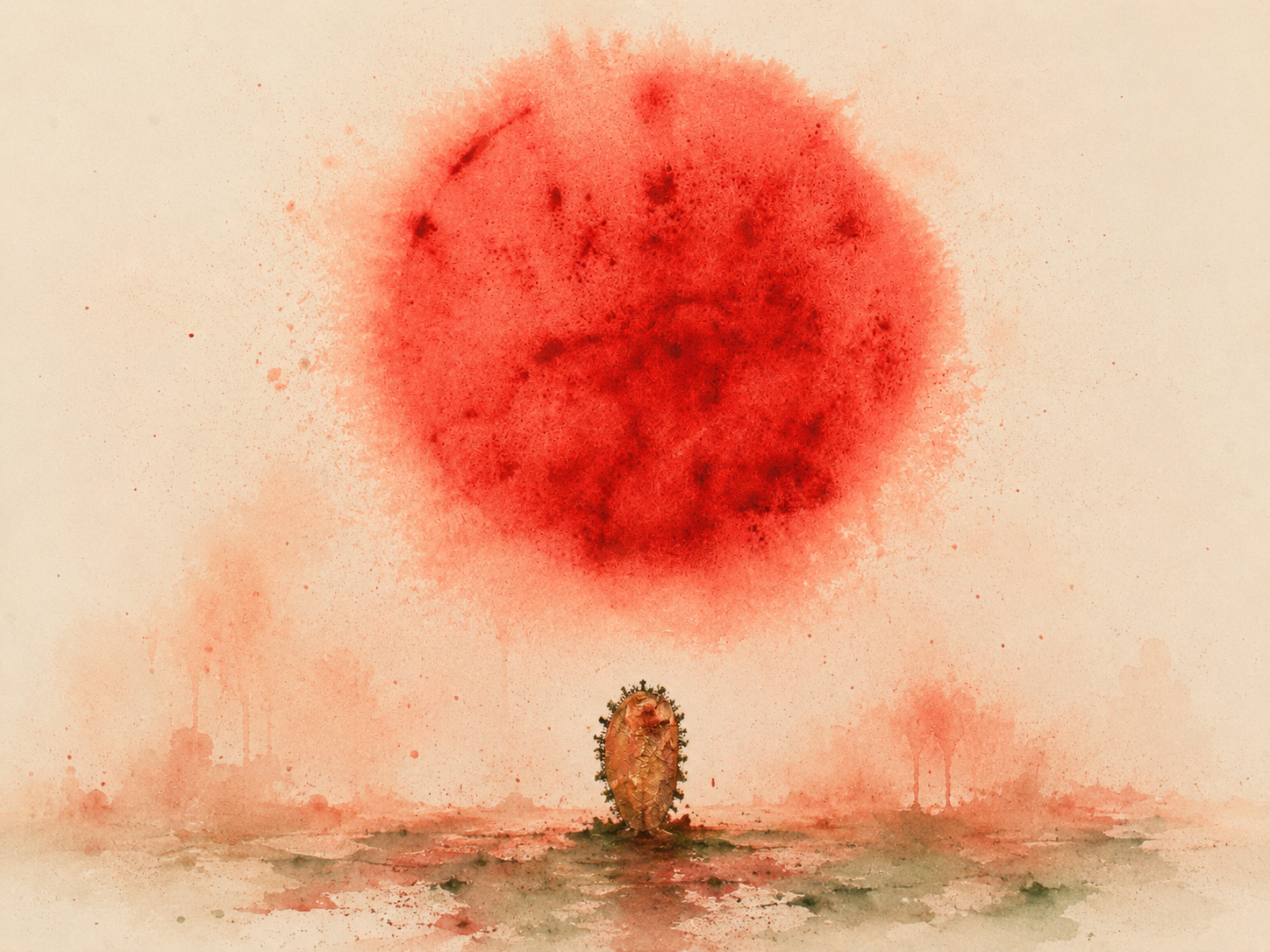
When she awoke, the virus was elated.
An empty, blood-colored sky opened in the cleft between the canyon walls around her. Beyond them, the world trembled as a vacant horizon line, cooking under the red giant the Sun had become.
Outside the fossil whale skull, where the virus had decided to wait out the end of the world, nothing else moved, walked, crawled, or flew. Nobody cried, complained, or spoke a word. No visitors from elsewhere had checked in during the eons the virus had spent in her slumber.
Finally, the virus thought to herself. Every part of her basked in the burn, from the lean, silvery missile of her head, down to the hook-ended tail fibers trailing out from her underside.
Fucking finally.
For as long as the virus had been alive, she wished for nothing more than a world as empty as this. With a yearning as unfeeling and fixed as the stone that surrounded her, the virus had waited, hidden beneath the seemingly endless stream of lives parading above her. One generation after the next came and went. Lives endlessly entitled and boorish, all with no lasting value to speak of. Still, they came, none exempt from the loathing she harbored for every one of them.
But her faith in a better world gave her hope. Mostly because it rested atop what faith rarely gets to stand on: certainty.
Death, naturally, would come for them all. It would come for her, too, of course. And she was grateful that, given the adaptive privileges she enjoyed, she had the means to outlive everything else and to find silence — sweet, sweet solitude — in a paradise all her own.
However, her dream would take time. A lot of it. After witnessing the process of bloat and collapse in the stars beyond the solar system, the virus could count on the Sun following suit.
So, long before the day she would wake to, when Sol itself began, very slowly, to resemble an overripe grapefruit, her body trembled with excitement. The true end of the star’s life was tens of millions of years away, and the redness marked an irredeemable countdown for the planet itself as well.
But the virus knew she was safe.
An adaptive protein sheath insured her insides against the nuclear outbursts thrown her way. And where previous generations of viruses had excelled as feverish duplicators, hacking their hosts apart in all kinds of brutally inventive ways, the virus had been blessed with a lineage that sidestepped self-destruction.
By way of a self-contained factory of reproduction within her own body, the virus’s particular species had traded away the need for a host, gaining the freedom to design and create future generations however she liked.
Coupled with a capacity for indefinite hibernation, the virus had everything she needed to outlive the neighbors she could not tolerate.
And wait, she did.
After she chose a glyptowhale to burrow into, swimming as it was over one of the larger trenches in the Pacific, the virus dispatched a fast-acting anticoagulant to her home.
The whale, well-armored as it was, could do nothing against her.
Within minutes, she had summarily executed the enormous mammal. The city of scutes along his back, which provided protection and a home for forests of seaweed and hitchhikers large and small, was soon awash in a red haze. Those that could escape their dying home vacated in a panic, darting away as the whale sank through a cloud of blood gone too thin to keep inside his body.
From there, the virus’s aim proved true. A perfect Goldilocks-zone of sediment, pressure, and lack of predators cushioned the animal’s final resting place. The odds against fossilization were still vast. But the virus had enough experience and motivation to make a well-informed bet.
And it worked. In time, rumbling displacements of silt covered the virus and her cavernous home. All oxygen was squeezed out, and she took the pressure in stride as bone turned to rock.
Above the slow mineralization process, millennia passed by. The virus waited with a bottomless patience as more lives, all obnoxious to her, were born and dispatched, consumed and made waste, fucked and made flashes of peace between numberless conflicts. All were pressed into the Earth’s strata like one giant, inescapable screw, boring through the ground to stamp impressions of what had once been, or disintegrating into nothing at all.
Pleased with her position, it was here that the virus began her first long slumber. Tucked away with qualities that made her nearly immortal, odds were good that waking would find her in a better place.
Even so, and in spite of her disgust for any sentimentality, she sent up what might have passed for the crudest of prayers before she slept.
Don’t stop.
Don’t stop, she told the red giant phase. She implored heat, plate tectonics, the fickleness of telomeres, even entropy itself to keep going, all physical forces that could do nothing else.
Do not fuck this up for me.
They did not.
The oceans continued to shrink under the livid growth of the Sun. With them went the last of the Earth’s survivors, vertebrates and invertebrates alike, and all plant life soon after, each clinging on in ever more stubborn and ever smaller varieties before the fate of the planet fried them into oblivion.
Millions of years passed over the virus’s hibernation. The new Hadean age took its course, neither rushing nor sparing its rage as it reshaped the world through superheated winds and tectonic spasms.
As it did so, the crust slowly surrendered the virus and her fossil to the surface once again, at a pace that could only be measured by the stratum that held her. There wasn’t much else to measure the time by. Night was a thing of the past, outshone by the Sun’s perpetual tantrum against the exhaustion of its fuel.
To experience the world as it was now, the virus could not be happier. If she could have breathed, she would have found herself breathless. Her faculties, fine-tuned to account for all manner of pressures and chemistries around her, took in the grandeur with what amounted to wide-eyed amazement, if she had eyes.
A metropolis of sharp traverses and pinnacles glimmered like ice in the ravine that had risen during her stasis, the leavings of the ocean encrusted over them. The planet, now emptied of fluff, was perfected in her eyes. Gone was the exhausting repetition of beings who insisted the world was meant for them; she had finally found the truth.
It was hers, the virus thought. All of it, the world she knew she deserved, irrevocably and finally, her own.
The virus unhooked a pair of claws from the fossil. The blasting wind whipped at her fibers, and she let the feeling take her away, riding its warmth with a contentment that only the truly satisfied can know.
So when the first meteorite struck the Earth, she definitely noticed it.
The rock screamed upon entry, scarring the sky with a trail of blackened elements at its back.
Its flight path ended with a seismic blow at the canyon’s highest walls, the crash throwing chunks of stone in all directions.
The impact shook through the virus, its shrapnel riding on echoes loud enough to be heard over the winds.
As dramatic as it was, events like this were to be expected. The slow death of the Sun meant extra density was being added to its volume, since the heavier element of helium was steadily replacing its billions-of-years'-worth of hydrogen fusion.
Adding weight bent space-time such that more and more heavenly bodies would be unable to resist its growing dent in the ether, and the Earth would catch more than its share of shrapnel as an adjacent bystander.
This meteorite was not the first, and it certainly would not be the last.
Still, the virus was not one for compromise, in any form. And she could not pretend that this interruption in her grand introduction to a world all her own did not annoy her.
It’s fine, she told herself. The last tendrils of debris were swept away by the winds, and the sweet, endless emptiness beyond soon returned to her.
After a while, peace returned to her mind. The silence and loneliness formed a vast nexus, like a throne grown to the size of an empty world, a place given to forgetting what was, which was now what the virus wanted most.
Without warning, the virus was jolted out of herself by a sound as though the ground had become the vocal cords of one enormous, screaming throat.
As her senses returned, a deluge of meteorites, large and small, high-pitched and thunderous, pelted the canyon and everything around it. With a frequency that could have been a downpour, but one that replaced rain with worlds, her chasm was slammed and carved apart by more and more fireballs careening through the air.
In spite of how shocking the torrent was, the virus tempered her panic with an unwavering confidence. She had been through worse to get here. Her body was what it was, and would certainly last through anything the melee could bring.
However, it did not take long for her microscopic perspective to give her a different cause for concern.
Amid the smatterings of iron and dust, the virus made out flurries of tightly packed granules. They had the form of roots made of glass, falling around her like snow glittering with a nightmare she could barely believe was there, but was.
The virus reached out, catching a few fragments of the bunched amino acids. Analyzing the sample up close, then even closer, she found another, more threatening macromolecule between her claws.
Carbon.
Fuck.
An especially large intruder laid a haymaker in the wall above her. The virus gripped her fossil even tighter.
Well, she thought to herself, what can these things really do? As common as bits of organic compounds like these were, the Earth could offer no more of a home to them than clouds to a fish. Anything life would need to take root here, water and oxygen being the headliners, had been reduced to footnotes in stone. Even if any aquifers remained, they would be far below ground, wholly inaccessible to the surface.
You’re in a good place, the virus assured herself.
Still.
The meteorites continued to rain down, the landscape blanketed now by a vertical storm front of rock.
It might not hurt to keep track of this.
Again, there wasn’t much to measure time by. So counting would have to do.
With 86,400 seconds to every full rotation of the Earth, a count of 172,800 would mean two full turns had passed. The virus guessed, conservatively, that if the planet absorbed a volume span, came and went without this shit letting up, then maybe, just to be safe, some anticipatory actions could be called for.
Within her protein coat lay the potential for creating any number of dutiful soldiers. With them, her peace would be enforced. If the right reaction brought about an outcome that would be, for her, forever intolerable, her offspring would take care of it.
The odds were in her favor. But so had they been in the beginning.
So, regardless of the odds against such a thing happening again, the virus started counting.
One of the most incredible spectacles the Earth had ever seen could not have been met with a more banal reaction. Blinding flares streaked the sky every which way, unleashing fireballs as big as islands, then entire continents. Smaller projectiles filled the space between them like gnats skittering between the work of predators on prey, laying into a fury that seemed bent on upstaging the Sun’s penchant for damage.
Still, the virus kept counting.
She had only just attained her dream. She wasn’t about to have anyone evolve out of the raw ingredients for life to interrupt it.
The bombardment tapered off at about 10,000, only to see a threefold renewal at 30,467.
Things got bad enough after 40,692 that the virus wondered if she would be smashed herself before the Sun had a chance to finish her off.
As she neared 50,000, the meteorites had been keeping up a steady, uninterrupted barrage for the duration. The rift around the virus had become increasingly shallow in that time, cowering away under the celestial hailstorm.
She reached 86,400. The pummeling continued unabated.
All right, thought the virus.
Next 86,400.
She counted away and was astounded when the onslaught seemed to tire itself out at the 159,784 mark.
Nearly finished with her tally of a full 48-hour cycle, the virus was surrounded by a smoking valley. Her monk’s cell, somehow, lay unbroken at its center.
In spite of the wind’s return, the steam given off by the sea of new craters rose at a steady clip, exhaling more clouds than the gusts had time to disperse. The moisture proved thick enough to fix a layer of mist just above the ground. Hot as it was, it slid over the virus, haunting her with the chill of a memory she would give anything to forget.
On its own, the mist wasn’t much of anything. Clouds, wind, and random bits of chemistry. A single step up from nothing, a grab bag of variables without order or intent.
If only, thought the virus.
If only.
She reminded herself that cynicism hadn’t steered her wrong so far, then inhaled deeply, or had the appearance of doing so.
Her sides tightened, drawing in as the forge inside her was jostled awake for the first time. Beneath her head, her tail sheath extended like an arm filling a sleeve, preparing for what she had been born to create.
With her place at the very pinnacle of viral evolution, her options approached the limitless. She could call up battalions of hackers, pre-programmed with retroviral infiltration skills. Or she could design bloodthirsty butchers, hungry to hemorrhage any living thing dry. Her children were hers to design as she wished, with options spanning from harmless spies to committed monsters. She loved it, and loved that her children, like her, needed no host to get the game started.
The most difficult part of this particular creation, however, was knowing next to nothing about who her enemy might be.
With only a smattering of ingredients on the table, the possibilities were next to endless at such an early stage.
She noted the elements in play. After tallying quantity and quality, texture and girth, she did it again. Then, she thought about what it was she was doing.
Observing.
You need someone else to observe, too, she thought.
Her innards wrote the order, and before long, her first operatives were alive, unspooling themselves from her chemical blueprints to roll out from the crown of pins at the base of her tail sheath.
The jade-tinted chains of new soldiers slipped out like reams of precious beads, wasting no time to rise up from the ground and turn to their mother.
“Monitor and inform, correct?” they asked in one business-only voice.
The virus pointed forward with her tendrils.
Go, she signed. Get going.
“Copy that,” they all said.
“Let’s get it!”
“Race you!”
“Get fucked, you had a head start!”
She didn’t want to hear their voices, much less her own. But, by design, they did not need anything else from her. Service was all they knew, and their ends would be accepted as gladly as their orders.
She could have loved them for their singular use and loyalty, if she allowed such a thing.
More and more rows of ranks whipped over the edges of the fossil. Each unit had inherited its mother’s capacity for self-replication and did not need prompting to begin multiplying. Emerald-green mats began to assemble and fan out, plunging into the curtains of detritus and steam that surrounded the fossil.
When all of her soldiers were gone, the virus leaned back, reclining in the rock. Once again, contentment eased the angles of her body. It was enjoyable for her, feeling her brood barrel into their charge. Maybe even inspiring. The way they rolled out together, overjoyed to meet their orders and the unknown to come, it looked, could she think it?
Fun?
She dismissed the thought, turning it over like a bad page in a good book, and the comfort of her home felt especially nice in that moment. The curvature of the bone caught her well, granting relief after giving birth. Reclining there, she reminded herself that, after all, this wasn’t about her army and what they were doing.
It’s about you, she told herself as she fell into hibernation again.
Just you.
A sky wrapped in darkness, that terror of terrors, welcomed the virus back from sleep. Her fossil hadn’t moved, but was now seated in the devastating expanse of the first night she had experienced in eons. Trillions of the clearest stars she had ever been under shot through a chilled breeze, completing her horror.
Wind.
Held and perpetuated by an atmosphere.
Please, no.
This was not the Earth she had left. It had become something else. She sensed it was still empty, yes, but no longer as inhospitable as the scene she had left to her spawn.
Possibilities rose through the virus, threatening to replace all of her thoughts with a single, forlorn scream, when a voice spoke.
“Milady.”
The virus focused on a sprightly, spider-shaped soldier kneeling on the ground in front of her. The sun crested low behind him, reduced to a smoldering sliver in the ocean of night around it.
“What happened?” the virus demanded. “How long has it been?”
“It is hard to say exactly, milady,” said the soldier. His body structure and lavender shell said as much. An epic gauntlet of evolutionary editing and hazing lay between him and her first children, born so long before.
“We have had,” he hesitated, “difficulties.”
“With what?” she said.
The soldier stepped aside. Behind him, a landscape covered with ashen parabolas and curls reached for the horizon line. Like farmland planted by some whimsically inclined harvester, the strange powder resembled topographical maps in some places, splitting amoebas in others.
From where the virus was, the bizarre patterns looked to be pointing right at her, singling her out with questions she needed to answer.
“The fuck is this?” she asked.
“We fight on, milady,” said the soldier. “It is not in us to stop.”
“You’ve been fighting dust for millions of years?”
“It is not dust, milady.”
“What is it?”
“It is difficult to say exactly,” the soldier said.
The virus picked up one of the particles in her claws. Given her depth of experience and knowledge, identity did not often escape her. But the closer she looked, the hard corona in front of her revealed only a pattern like marble. Razor-edged, but not particularly rough to the touch, pale whorls looped around inky hubs, from which long tendrils reached for a seamless border.
No membrane of any kind could be found, and even the constituent elements were a mystery.
She gripped the mystery as tightly as she could, and that did not surrender anything either.
Then, without fanfare or warning, the near-weightless speck became more than weightless.
The virus opened her claws, and two identical twins floated in front of her. They paused, then whirled away on the cool breeze that found them.
It wasn’t like anything the virus had ever encountered before. But whatever it was, it had replicated itself enough times to cover everything she could sense.
“It has no DNA,” the soldier said, answering a question she hadn’t asked yet. “No RNA to transmit anything either. We are not even sure what it is made of.”
“It can’t host anything you’re throwing at it, either,” she surmised.
“Correct,” said the soldier. “There is no place to gain even the smallest of entrances. We have tried. Burning, cutting, crushing, blunt force. Nothing works. And it just keeps growing until, well,” he said.
The swarms that surrounded them finished his thought.
Fuck me forever, thought the virus.
“Impervious,” she said. “That’s what you’re trying to tell me.”
“We are still trying, milady, I assure you.”
“You have everything to work with, so what isn’t working?”
“The right job cannot be rushed,” the soldier said. “But I will be the first to say, we are not you, milady.”
“That sounds like blame, soldier,” she said, an icy flatness in a tone already livid.
“It is not, milady.”
“Sometimes things don’t sound like what they are. So please, try again.”
“This is not Earth, milady,” the soldier retorted coolly. He gestured back to the long spokes of non-life that, somehow, had interrupted the lifelessness of the planet.
“And that is not life, as we understand it.”
The virus let a pause sharpen between her and the soldier. It would have been easy to engulf him in her hooks. She would barely have to try to slice into his fatty outer layer, grab hold of his core, and send his insides to splash on this landscape of failure.
As good as it felt to consider, it was exhausting to think about in any real terms. In the end, she’d do anything, anything to keep from touching him. It was hard enough to know how long she had waited, and how much longer she might have to wait for what she needed to find.
Had found, thought the virus.
“Figure this out,” she said, sinking back in the fossil.
“Of course, milady,” the soldier said. He saluted, but the virus had already begun the escape that was sleep once again.
When she awoke, the stars weren’t there anymore.
This would have been a relief for the virus if the ground wasn’t glowing brightly enough to blot out everything else.
Like a sunset caught in a seashell, the light that surrounded the virus was subtle. A shimmering powder, grown beyond the dusty beginnings she had seen ages ago, swam in a warm, haphazard mist all around her.
Here, the waves of light gathered in many-layered channels. There, a swirling corkscrew formed a spring, pointing up, then curling over as if beckoning. Every form was made up of millions upon millions of pieces, restless and in harmony, inorganic and alive.
The odds of this happening were as microscopic as she was. But, genetics or no, the virus could not interpret this as anything but life.
As she came to this quick and devastating conclusion, a mass like morning mist barreled through a party of bouncing white wisps. The smaller bodies were consumed for a moment, then popped outwards, spinning into a many-toothed mane as the cloud rose into the sky.
Further on, what appeared at first to be a background of haze flexed and scooped the sky with massive sails. Triple-headed tornados transitioned through shapes like boomerangs, zeppelins, various organs, sashaying among dozens more of their kind, without aim or disagreement.
Beneath the storm of festivities, the virus seethed.
She had waited. She had waited longer than anything else ever had, for anything.
She had birthed a self-replicating army. Just to be careful. Just in case it got worse.
Intruders, as always, flourished anyway.
Whatever this new medium of life was, it had not only demolished the forces she deployed — these lives had rewritten what life could be.
No source of sustenance seemed necessary. No exhaustion could find them, and no standard form could keep them from becoming whatever they wanted to be.
The virus, incensed, knew she was looking at what had risen to become the most successful life form possible.
Even so, there was still something else she could do.
Microbes had contributed much to the planet’s atmosphere before. Upon being caught up in the heights of the sky, many grew heavy with ice in the frigid temperatures.
Therefore, if they were set in the right position, the right offspring, sufficiently numerous, could change the planet.
The size of the virus’s conscripts meant their numbers would take quite a while to have any impact.
But, without options, an epic gamble was all she had.
The virus wrote the code in a frenzy. She drew wide berths for the new soldiers’ bodies, giving them flight. Their hides were pocked full of holes, enabling them to both eat and birth squadrons at an exponential rate.
One draft after another poured out of her. She could not say how long it took for her to find something trustworthy. Seconds. Centuries. She would not rush perfection, and she did not.
Then, when she started to doubt a final draft could please her, they were there.
A quick spray, then a river of troopers spewed from her tail. The chattering, spongy-skinned seedlings were not without respect. Each of the crowd bowed her way upon birth, then took no time at all to go airborne. Squalls of them entered the windswept fray, the new lives their mother hated so much.
Soon, all were lost, digging themselves deep in the low glow of their targets.
If the populace noticed the incursion, they showed no sign of it. Onwards they galloped, slid, and glided among each other, as playful as ever.
This will take time, the virus assured herself, taking in her landscape-sized enemy.
She knew her soldiers were hard at work, eating everything they could to multiply.
It would take hundreds of thousands of years, maybe even millions more, for anything to take root.
But, having already waited this long, the virus found patience no problem.
However, the Earth would end, whether in a heap of ash or frost, she would meet it on her terms, and no one else’s.
When the virus awoke, again, the final bouts of the Sun’s fusion welcomed her. What remained of the star now threw out long, white-hot arms of plasma like an octopus made of fire, as if to toy with the Earth, a meal it was too weak to catch.
But none of this held the virus’s interest.
Beneath the shimmering filaments, an inferno, alive and ecstatic, danced before her.
Peopled by waves upon waves of what seemed to be individual flames at times, any number of shapes and acrobatics at others, the light of life’s newest incarnation stretched as far as the virus’s senses could take in. There was no telling how many individuals there were. As far as the virus could tell, this new life, these oxidizing, what could she call them, fucking sprite-imps, like their piece of shit precursors, showed no attachment to one shape before changing into another.
Indeed, with voices like the howls of a well-fueled pyre, there were few differences to be found between the scene and the biggest bonfire one could imagine.
Until it began to build itself up.
The virus, finding new levels of hopelessness, stood under hordes of dancers beginning to fuse and form a layer, then another. Soon enough, a pyramid began to rise, with smaller members tossed up to an off-center pinnacle.
Suddenly, a trio of sparks bolted over the virus, jetting for the slope from the remains of her canyon. Together, they gathered as much speed as they could, bearing down on the massive ramp formed from their own kind.
The virus could have wept as each racer sliced up the incline, took the air, and transformed itself into a multi-winged hybrid of seraphim, combat drones, and fire-tongued eagles. Zipping and gliding and cresting through the night sky together, the legions below cheered them on, taking on all manner of shapes and sizes as they did: sultry lines wearing only allure in the smoke that rose from their bodies, spiny-backed, skeletal terrors cackling in tandem, all celebrating their comrades, and celebrating the celebration, igniting more sparks and smoke where they high-fived and hugged the fliers and each other like this was the best thing that had ever happened, until the next racers began to line up for their turn, which was, in turn, the next best thing to happen.
The virus, forlorn, crumpled against her rock. Nothing as gorgeous or infuriating had ever come across her path before. And, of course, she knew it was on her.
For every aggression she had made through the ages, life’s retorts had been happy to accommodate, then sprint. Even with the dire conditions of the game board, one triumph, clearly, had followed another.
Here, at the end of the planet, the virus was crowded in by her unwitting children, flourishing at a sprint. To seek any niche for her wares in this place, with these, what, oximorphs, would be like arguing with an avalanche.
As if to drive the point home, a new flare began to grow, then arch out of the Sun. The massive limb lurched through space like an ill-tempered leviathan. It was large enough to swallow any number of worlds, and no target lay in range besides Earth itself.
Whether this would be the case or not, the oximorphs, already delighted beyond words, outdid themselves with anticipation.
Moving as one in a delirious furor, they formed a colossal, single-minded river. Once amassed, the swarm of bodies began to extend out and backwards, opening like the hands of an enormous outfielder, reaching back to catch hell itself.
The tower of plasma gained speed, falling towards them all like a felled tree in flames.
The virus recoiled into her fossil, quaking in spite of herself. She had never given much thought to whether anything would follow this life. This one had disappointed her enough, no matter what she did to make it her own. With only a line of defeats following one after another, an end to them all did not sound like heaven, but it outclassed the hell she had found in this world.
The flare grew larger.
Then, like a guillotine of planetary proportions, the gap closed.
The roar of the emission cracked the ground and flattened the space above them all. The sound threatened, promised to end everything when, at some agreed-upon signal, the immense union of oximorphs leapt upward to meet the flare.
The virus was left alone among the rocks, slumped in awe as the canopy above her turned brilliant white. Their singular blaze, held fast by an embrace they all shared, floated for a moment, robbed of weight as nourishment and joy spread through them all.
Then, as quickly as they had risen, the oximorphs sank back to the ground, cushioned by a single, collective sigh resounding through every last one of their members.
In all of her years, the virus had never been stunned before. She did not know what to make of such a feeling. She did not dwell on it for long, for as she directed her senses upward, she found someone had already put their focus on her.
A face, or as much of a face as a flame can have, looked straight down at her. A pair of cool blue eyes, set in a flurry of curling oranges and whites, took her in she didn’t know how, what with how tiny she was and how large the oximorph had to be.
Nevertheless, the face looked on with unbridled wonder, then turned to speak to the crowd.
“Guys,” he called out. “Hey, everybody!”
The multitude, still simmering with a profound satisfaction after the flare, did not respond at first. Their just-received sustenance flickered as deep violets and golds through their bodies, playing well with the lazy cuddling and laughter they shared with one another.
“It’s her!” the observer shouted.
That did it.
Dozens, hundreds, then thousands more gazes zeroed in on the virus. A valley of them formed around her, humming with admiration, the virus, again, felt totally unprepared to meet.
She had never felt such a connection before. It was the first of any kind she had felt, really. But there they were: her unwanted populace, as reverent as subjects before a god made suddenly visible.
“You know I’m here,” she said finally.
She regretted it immediately.
No shit they know you’re here, she thought to herself. But the first oximorph to speak to her replied with a wellspring of respect, as if he had been waiting all his life to respond to such an ingenious comment.
“Like you, we sense everything,” he said. “We’ve waited for as long as we’ve been here to thank you for that. And for everything else you have given us.”
The first shock of the virus’s life was dwarfed by this, the second.
“Thank me?” she asked.
“Well,” said the fire, raising a limb shaped like a flipper to qualify himself. “We try to be as observant as possible. Which is to say we know nothing, next to you. But please don’t think that we don’t know what we’re talking about. Or misunderstand your surprise.”
Another new and uncomfortable emotion ran through her. Of course, they knew she’d done everything possible to keep them from living. And she had never known lives so beautiful before. To look at them now, these impossible beings of raw jubilance and grit who had only gratitude for her, the virus nearly forgot what had driven her here, to this place.
Nearly.
The virus bowed.
“I wanted to be alone,” she said.
“Listen,” said the flame. “Whatever you meant to do, and whatever drove you to do it, failed. In spite of your incomparable abilities, brutal tactics, and brilliant implementation, nothing went right. Over and over. All of it worked to make us, and here we are.
“But,” the oximorph said, a smile growing across his searing face, “from what we can tell, and we can tell a lot from what we’ve found in the rocks here, nothing’s done well on this planet without getting fucked really, really hard first.”
The oximorph swung an arm to take in the Sun’s dying.
“This looks like the end,” he said, “but it’s not. You carved the weakest parts out of us long ago. You did it once, but when we still weren’t good enough, you did it again. Now, as you can tell, we live by feasting on some of the most destructive forces in the universe. We even give back to them.
“When we leap up to meet the flares that the Sun whips at this rock, we accept its heat. And in accepting, we part with a bit of ourselves every time. In this way, we sustain what feeds us and grow with our giving.
“The Sun doesn’t have much more to give of itself. Eventually, we may have to give ourselves over to it completely, and in doing so, sway its fate by riding the emissions back to their source.”
The oximorph shrugged. “But we’re not worrying about it in the meantime. For now, we keep the party going. And we can never thank you enough for all of it.”
The oximorph’s face, all tongues of flame and kinetic ambition, waited in front of the virus. Behind him, millions of his ilk glowed with a gentle blue appreciation.
But as the virus’s shell reflected the brilliance that surrounded her, she remembered what put her here in the first place.
Solitude.
As much of a respectful distance as the oximorphs kept between themselves and the virus, isolation eluded her still. And even with all the praise and thanks these remarkable people gave her and her efforts, the longing to be alone hadn’t left her.
The oximorph sensed that, too. He slunk downwards, halving the distance between himself and his creator.
“You waited a long time for everything to die,” he said gently, “then you did everything you could to kill anyone who crossed your path. You wanted to be alone. I can’t relate, personally. Physically and philosophically, I just can’t do it. But it must be a wonderful thing if it won’t leave. So, do not let it go.”
She wouldn’t. But, for the first time, the recognition of how she felt was here, and her child praised that as well. That counted for a lot.
For now, a pool of contentment, neither too deep nor entirely chilling, immersed this need of hers.
But she knew, as this son of hers did, too, that satisfaction never lasted.
The virus would rest. Problems always do, for a time, and she was a good problem. Like all problems, good and bad, she would take her leave for a while, until she would have to try and make more of them again.
As the virus weighed the options of speaking or finding slumber again, the thought crossed her mind that this was how life might have come about in the first place.
Someone just wanted to be alone. And then, as if to punish anything contrary to the inelegant, self-aggrandizing ordeal that was the essence of life, the universe ensured that such a thing would never, ever happen.
Especially for a being that wanted no part of it.