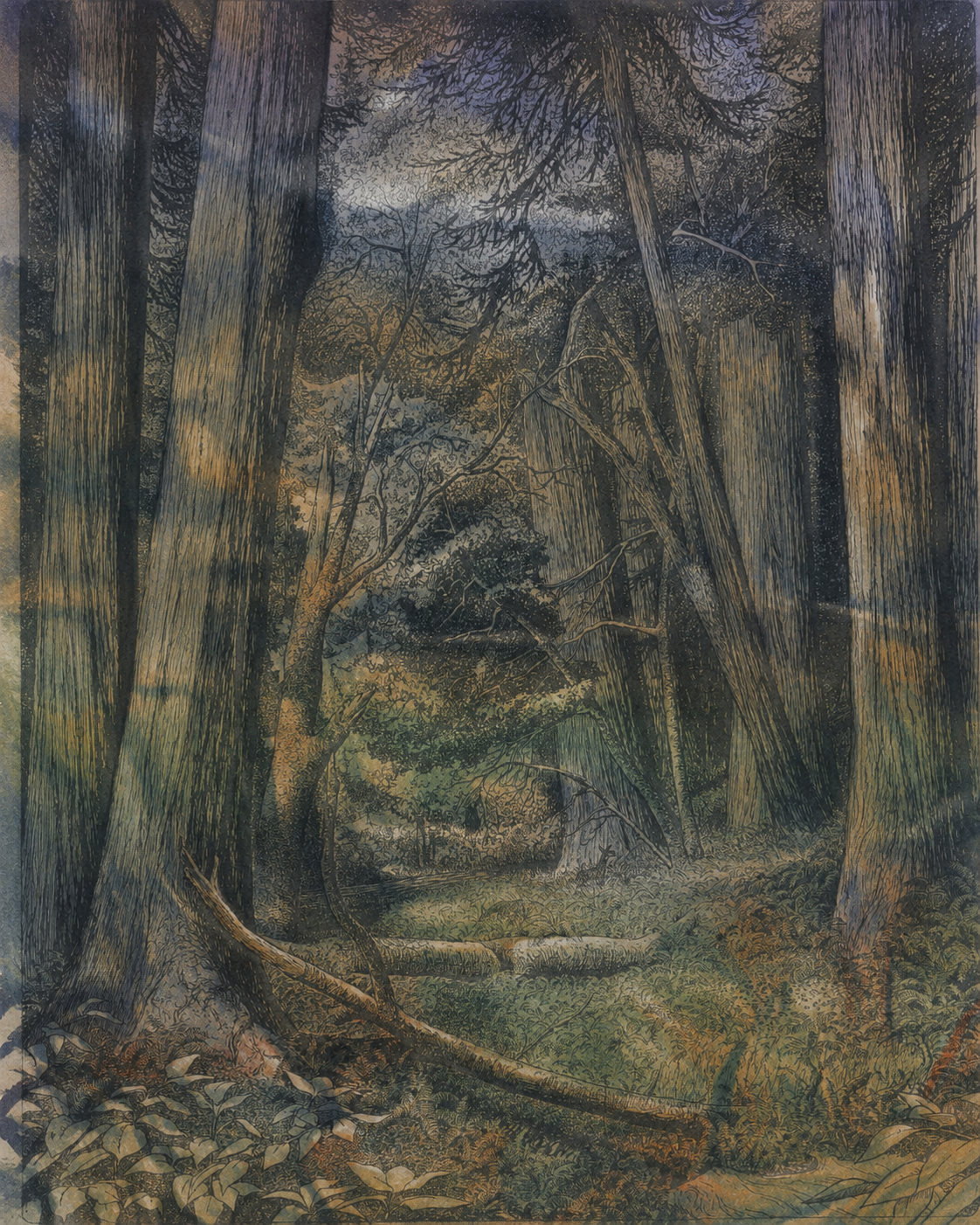
Our mission was to find the source of the blue light and analyse it. We first had to cut through the normal woods: the messy, chaotic, beautiful wilderness of the national park, where the air was filled with sweet fragrance of Mahua and the undergrowth was a tangle of moss and the unique scent of decaying leaves in the damp soil. Life ended abruptly as we crossed the perimeter and entered the Thicket, the air tasted sharply of burnt wiring and old rusted coins, a noxious scent that stung my sinuses without causing pain. It was the first, and perhaps the most honest warning that we were no longer in nature.
I knelt on the strange, white soil, that felt like cold porcelain, and unnaturally compacted. "The uniformity is the horror," I murmured—a sound that felt hollow in the complete absence of any ambient noise. "Look at the angles! The trees aren't growing toward the sun; they're growing according to some abstract rule, that has not been seen in this world." My intellect, my greatest strength, fixated on this sterile precision. "This portion of the forest appears to be some sort of clean room built on a geometric logic we don't understand. We need to collect data and figure out this anomaly."
Jaya, our system expert, was already experiencing trouble. She pulled off her now useless headset; the screen glowed with a single looping word: IRRELEVANT. "It's some form of data cancellation Doctor," she said, her voice strained. Before I could process that, her drone whirred to life, its winch tightening its cable and began dragging her violently away from the perimeter. "It's taking control of my system!" she screamed. I grabbed her as Mohit took out his combat knife to physically cut the thick tether.
The realization hit me like a physical blow: Something in here was re-routing and weaponizing our instruments against us. We were the first research team to enter the Thicket in order to understand the anomalous zone, but I should have predicted this from the previous failed attempts.
Mohit was struggling with the atmosphere, "The silence in here is very unnerving," he grunted "I can't even hear the leaves rustling, let alone any fauna." The air was pressing us down, blurring my own vision with a subtle, disorienting force. I fought the irrational urge to stop, to simply surrender to the perfect stillness the forest was radiating. "This place feels too oppressive with lack of any sound," Mohit re-iterated. "We should move fast, not give in to the stillness, and we trust nothing but our feet."
Fifty odd steps in, we reached the crystalline fibres. Iridescent, rigid threads strung between the pale branches, flashing with a subtle internal light. They looked akin to complex computer flowcharts rendered in bright, cold energy. The air was colder, thinner, making my lungs ache for oxygen.
Mohit reached for a fibre with his knife, instantly, the entire lattice structure around us flared violently with blinding white light. A fibre near Mohit's shoulder vibrated at an inhuman frequency, and he screamed. "It's a security perimeter!" I yelled, shielding my eyes, "It's architectural! The whole place is the system!"
We're not sure how long we were all knocked out for, but we gained consciousness around the same time. We decided to continue our walk towards, what we thought was, the centre of the Thicket. We stumbled upon some form of evidence quickly. A backpack-like structure suspended in the web, and below it, the perfectly preserved, crystalline figure of a missing hiker. My mind immediately categorised it: Data Echo.
Jaya reached out and touched the figure's neck to check for pulse. "It's not killing us—it's archiving the information," she gasped. "I saw her life in five seconds. Just a list of facts and major events. It only cares about the file size."
That was the key: The Echo was a life reduced to a database entry, stripped of story, joy, or chaos. I forced myself to record an observation, pulling up my wrist device.
I suddenly felt the first cold, sickening intrusion. I watched Mohit recoil from the Echo, his face pale. If the Weaver has archived the hiker's life as data visualisation, what is it doing to ours right now? The question, logical and terrifying, immediately prompted me to test my own mind. I tried to mentally recite the names of my great-grandparents, names I knew instantly, but found the faces, the voices, the specific texture of the memory had gone flat, replaced by mere labels. The Echo was prophesying my past.
Mohit was experiencing his own breakdown. He tried to recall the specific trail he hiked with his grandfather. He realised he only remembered the trail map, not the memory of being there.
He grabbed Jaya, his grip desperate. "Tell me one thing only we know. Now!"
They went over their personal history, and both agreed that the sound of laughing, tears and other feelings were gone and replaced by a generic fact.
The shared observation confirmed a truth, and a cold, logical dread seized me. I immediately tested the integrity of my professional identity. I tried to recall the standard operating procedure for a high-level bio-hazard, a sequence I could recite in my sleep. The steps flashed in my mind, but they were isolated and floating. "The chain of logic is broken!" I realised, my voice rising in panic. "I can only recall isolated facts, not the sequence. It's like my brain has zeroed out the importance of the process!" I wasn't just losing memories; I was losing the ability to think sequentially, the very core of my identity as a scientist.
"The fidelity is impossible," I muttered, frantic now. "It takes an all-knowing level of computing power to render somatic memory as well as epigenetic data this way."
We heard a roar, as we got to see the Weaver actively working on a sloth bear being scanned. The shimmering threads crawled over its shaggy form. I could see the information being pulled, extracted. The bear's silhouette was solidified into a crystalline echo, and the original animal fell to the ground, a wet husk of skin and bone. The life itself had been neatly excised.
Jaya looked at Mohit, trying to shout his name, but the word came out wrong: "Subject 3." I saw the terror in her eyes as she realised she had lost the unique details of their friendship. She clawed at the strange soil. "What is my mother's name?" she whispered, her voice a ragged thread. She knew the letter… A… for Anjali… but the feeling associated with the name itself was a vacant space, a file corrupted by deletion.
Then the horror came for me, fully and completely. I stumbled and looked up at the shimmering tangle of threads. My sister. Her wedding. She was planning to wear her grandmother's sari… The data was missing. Then the truth struck me, worse than a physical wound: The wedding hasn't happened yet! The Weaver had already archived a completed version of her life. Our future was a settled, indexed file, already recorded in the Weaver's eternal database.
"There!" Mohit strained, forcing the sound past the stillness. He swung his knife at a gap, but the fibres simply parted for him, then snapped back into place like a massive, automated gate. The Weaver was directing us. Our hope was merely a calculated exit vector.
Driven by a fading, basal instinct, we stumbled toward the boundary. The transition line was only a few yards away, but it felt like wading through solid water.
I, the scientist who lived by logic, performed one last, desperate act. I stopped at the edge of the Thicket and, looking back at the vast, unfeeling expanse, I deliberately chose to believe something illogical, something messy. "Take this, you perfect machine," I screamed silently into the crystalline expanse. "I believe in messy, illogical souls. Archive that!" I attempted to provide the Weaver with a piece of corrupted, non-quantifiable data in my final submission.
We fell out onto the normal, messy, mossy earth. The Weaver did not pursue. The air here smelled richly of life and beautiful chaos. We could hear the birds and the insects, and even the rustling sound of the leaves. "We… we did it," Mohit choked out, but I felt only a profound weightlessness. I looked down at my own hand, watching the fine lines of my knuckles, and realised I could see them only as texture data, not as the unique markings of my own body.
I ignored the feeling, moving into cold analysis. I focused on the loss of my father. I knew the facts: Date of passing, cause of death, last conversation topic. But the feeling, the unique texture of the emotion was simply gone, replaced by a clean, factual entry. My survival felt more like a hollow, analytical shell.
The rescue team found us. The medic, a kind-faced woman, asked Mohit a simple, necessary question: "How are you feeling right now?"
Mohit looked at her with a confused look. "I am not sure, I remember that I used to be afraid of heights," he said, without a single tremor of fear. "I can't access the feeling. It's just a fact now." But his voice wasn't that of someone confident but it was devoid of inflection, a pure recitation of data.
Jaya, her eyes fixed and empty, managed to reboot her rig for one final, desperate photo of the perimeter. Overlaid across the image was the same faint, impossibly complex structure—a filigree of pale blue light that resolved into a single, three-dimensional helix.
I looked up from the photograph and for the first time I could see the pale blue light myself, I was unable to look away from this code that shimmered in our physical world. I wasn't searching for a defence mechanism or a warning, but for a reason why it had let us live. Then I saw it: the entire structure was a data label. It was the unique classification marker for the complete set of human profiles within the Thicket's storage.
The Weaver was out here for its field research. It hadn't failed to archive us; it had checked our box and moved on to the next task. Our data was sufficient, indexed, and filed.
We were alive, but that fact was either purely coincidental or a nod towards our scientific temperament.