I never would have chosen this life if Nadine hadn’t walked out on me that way.
It was hot. The sky over Denver was intense blue, the few high clouds brilliant white smears. Coming back from final exams, I was exhausted but elated, thinking about trips we could take together now that I didn’t have classes to attend, assignments to complete. The mountains called. There was a whole summer ahead for us before I started law school in the fall.
I opened the door to the two-bedroom walkup we’d been sharing with Klaus and his girlfriend a block off the university’s main campus. Once a small private house, it had been divided into two apartments, one up, one down, shabby without being a dump, on a street with other converted houses catering to students and the occasional pensioner who fed off the proximity of youth.
Nadine was sitting in a folding chair at the laminate-topped card table in the kitchen, her scuffed and dented metal rollaway beside her chair. She was five feet six, whip-lean, with a mass of curly black hair that framed her oval face. She looked up from her social feed and said, “I’m leaving.”
Just like that.
I stood looking down into her blank expression, suddenly unable to breathe, feeling as if I’d been smacked in the head with a mallet. I heard ringing in my ears. “But I love you,” I said because I did and because I thought it mattered. “I know we’ve been arguing lately but...”
She shook her head. “I want a change. I don’t want to – I don’t want. You.” Cold. Unemotional. As if whatever intimacy there’d been between us had been faked, a performance. So no, we weren’t a couple anymore. Smack. Just like that.
She closed her net link, got up, shifted her backpack onto one narrow shoulder and walked out, dragging her rollaway behind her. I listened to it bump down the fifteen bare wooden steps to the door below. From a front window, I watched her until she was out of sight. I turned and looked around the apartment, the shabby, rumpled, sagging sofa, threadbare throws over torn upholstery, pinned posters peeling off yellowed walls. All the stuff in the kitchen that had wrapped us in warm domesticity, all its magic gone with Nadine, revealed itself as nothing but the flotsam of generations of transients washed up on the countertop, in the sink, the drawers and cabinets: hand-me-down dish towels; chipped mugs and plates; dull knives, mismatched forks and spoons; scored and warped cutting boards.
After she left, I tried to go on, but I couldn’t. Fiery rage and black depression drained me to exhaustion. I skipped my own graduation and sent apologies to my parents. Some days I couldn’t even get out of bed, the same bed we’d shared, the weight of grief and shame and anger, the weight of memories, was too heavy to lift my head off the pillow. The idea of more school seemed ludicrous. A month after she left, unable to do more than drag myself through one empty day after another, it was either step in front of a moving bus or …
So I turned my back on the world, turned away from the blue sky and the green earth, the blue oceans, crackling wood fires, paw prints in the fresh snow, all of it. Turned to space. As far from Nadine as I could get. To the wide marble steps of the Transport Company’s headquarters on the north side of downtown and the tall bronze doors that slid open and ushered me inside to become a wormhole driver.
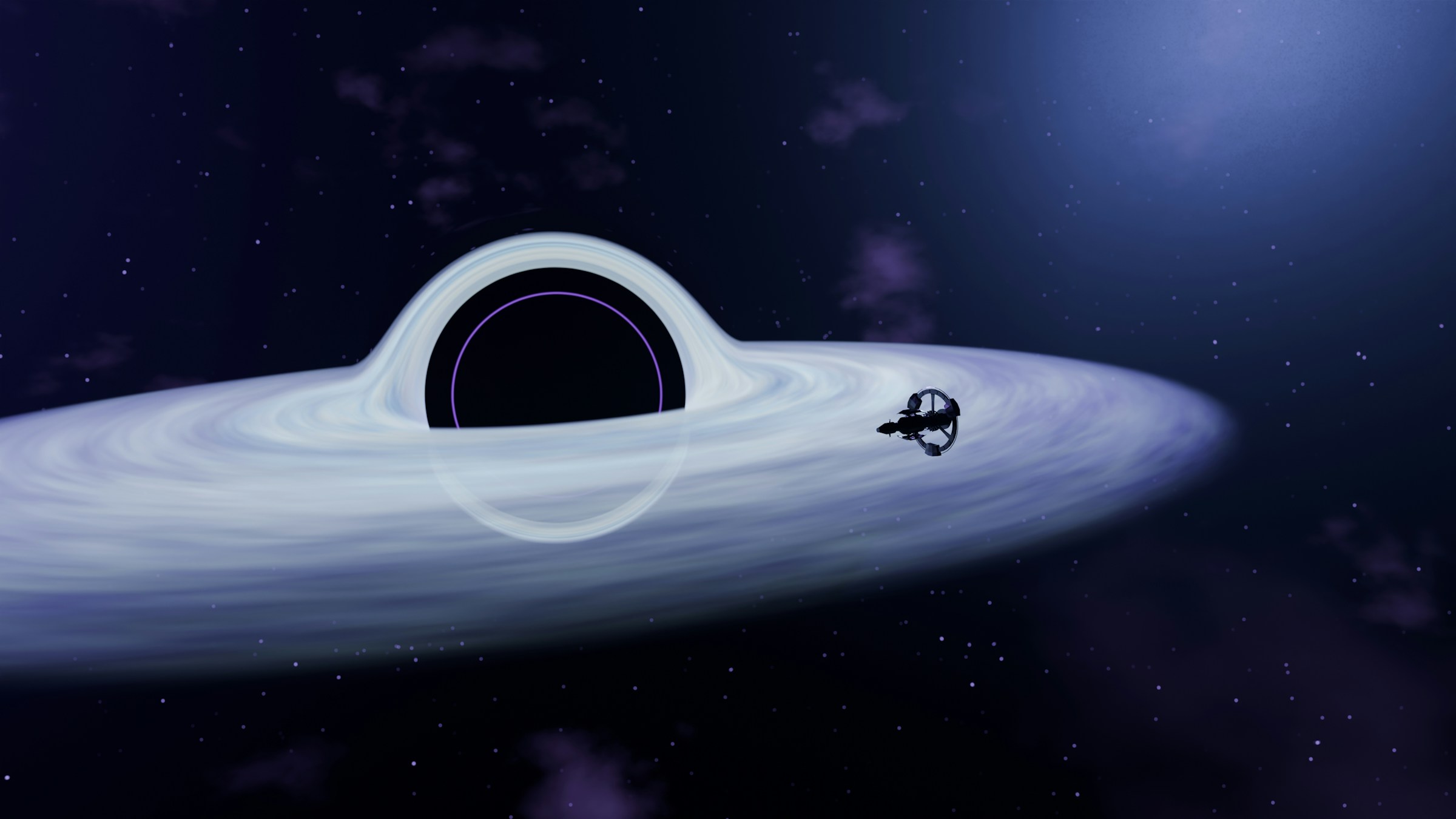
A vast hologram of the Milky Way filled the entry foyer, billions upon billions of blazing specks of colored stars and wispy veils of nebulae in the six tight spiral arms that curl inward to the brilliant central ball and the supermassive black hole it hid. The sight was so awe-inspiring I stopped in my tracks at the outer edge of it and tears formed in my eyes. Leaving Earth behind, I crossed through the hologram and into my future.
Testing and selection were perfunctory – a talking dog could qualify. The training, too, was perfunctory: three days of laws, policies and practices salted with Transport Company puffery. Nothing about the science or technology; the silicon brains did all that.
I learned this: they call us wormhole riders, but spaceships don’t travel through holes in the universe, and we don’t ride them. Ships pop – that’s the word – into a dimensional-mathematical something that isn’t our spacetime and pop back out when the onboard computers tell them to, like a toaster popping up a slice of bread. That’s the way it’s described in the training materials. The visual is a slice of toast dropping into a toaster and popping up when a timer dings. Some still call the dimensional-mathematical something a wormhole, but I think Toaster is much simpler.
The ships even look like slices of toast, aggregations of standard-size, standard-shape containers: intermodal cargo containers; intermodal tanks for holding liquids and gases; passenger suites; flatbeds for carrying industrial machinery and the crew module. The particular pieces that make up a ship depend on the trip, all snapped together and sealed into a single mass by a thick locking band very much like a bread crust that contains engines and a headhouse where the crew and the computers run the aggregation of parts that makes up the ship. Hence the term slice of toast, or slice, for a ship, and popping for the process of folding a slice into and out of the Toaster. Actual travel happens within the Toaster and is instantaneous in our spacetime.
A Wormhole Rider is really nothing more than a crumb on the crust of a slice of toast.
The Company’s PR department insists on calling us Wormhole Riders, though, and requiring us to wear uniforms with embroidered doodads and pins identifying us as Captains of the slices, but we don’t operate the slices, the silicon does. We don’t even captain the shuttles that take us from Earth to the far side of the moon and the terminal that’s not-so-cleverly named Far Luna, where slices operate from. Shuttles and slices captain themselves, autonomous, like transports have done everywhere for generations now. So much for the glory of being a Wormhole Rider.
Government regulations don’t say why slices still require Wormhole Riders; it’s probably lobbying from the union, if you can call it lobbying; at this point, it’s more like institutionalized blackmail. Not that I’m complaining. Our real work is helping the people aboard do the work planned for their stay at the destination. Sometimes it’s scientific research. Sometimes it’s delivering equipment to a mining operation or taking on a load of water ice from an outer moon like Enceladus – the backbone of the Company’s business – or of rare ores from other moons, or chemicals that can’t be manufactured on Earth made in factories in orbit close to the sun.
Sometimes it’s shepherding a bunch of tourists who want to see Saturn’s rings up close or steal pebbles from Pluto to take home as souvenirs. Sometimes I think I’m doing the same work my great- great- grandfather did in an Amazon company warehouse his whole working life.
The only part of the training that interested me was how popping affected us. During a pop, everything in the slice, including mind and body, is escrowed, as if frozen inside a box, and released when the slice pops out in our spacetime. Then, in an instant, the box opens and time catches up for everybody and everything that’s been in it.
I imagined a pop to the nearest star to ours: four years’ worth of hair ripping out of my scalp in the blink of an eye. More gruesome things would happen inside my body. The silicon simulations say screaming, explosive death and the Company has never felt the need to sacrifice a lab rat, let alone a Wormhole Rider, to test them. Probably because the legal definition of murder still covers such a test. Even for the rat. Go figure.
Silicon minds, on the other hand, can handle instantaneous aging just fine. At least up to a point. Because what’s 9½ year round trip to Proxima Centauri for silicon? Nothing. If the Company wanted to pop a slice to the center of our home galaxy 26,000 light-years away, it’s not beyond the realm of possibility that properly engineered silicon could survive the trip and return safely. It was obvious to me, son of a lawyer, that government regulators and Company masters alike reluctantly acknowledged that humans were not built to travel to the stars, at least not by popping and certainly not by slower-than-light journeys through usual spacetime.
Deep space belongs to the silicon, not to us.
I enjoyed the work, and over the years I spent as a Wormhole Rider, I learned the dark side of the business, that many quarters in the Company and the government resented the limitation and feared the silicon because it was limitless in spacetime; that many idiots have tried to modify the human genome to enable us to withstand or avoid the effect altogether. Every effort has shown outcomes worse than poor, and occasional criminal convictions for the attempts have been the only results to date. That doesn’t stop the occasional rumor of a secret breakthrough from spreading.
Still, there’s a lot of business to be done popping around our Solar System. Wormhole Riders continue to be employed, and we put up with the slow toll that small, frequent, instantaneous aging events take on us in small doses over the years. After all, a job’s a job, the pay is good. Not as good as I’d have made as a lawyer, but enough for me to live comfortably in a one-bedroom unit in a “luxury” dome near Far Luna Terminal, not one of those early converted containers that always leak air and never have enough insulation to keep out the cold of space. And my one true indulgence, a cottage on an island off Espoo that I retreat to twice a year to get the feeling of Earth's gravity again. And sauna.
It was in nearby Helsinki, twenty Earth years or so after I began popping, that I ran into Nadine again. I was recovering from a minor procedure – multiple myeloma scrub; somehow my parents failed to inoculate me – standing at a coffee booth in the Kauppatori outdoor market at the harbor drinking a tall cappuccino – real coffee, not kaf – watching Finns shopping at the booths as they have done for hundreds of years. And there she was, not three meters from me, fingering a display of polished Martian stone bracelets. The kind of thing teenagers like to wear these days.
Her hair had grayed, and she’d filled out some but I knew her instantly. She was dressed in a brightly colored maxi dress of blobs of reds and yellows and blues. Thick boots peeked out under the hem and a woven string bag hung from her shoulder. The polished stone bracelets she was looking at – did she have children, nieces or nephews? A partner?
I did feel a brief adrenaline shock stab my gut and flush my face when I saw her, but it wore off quickly. She was just someone I used to know. Twenty years will do that. I was debating whether to call out to her or let her go her way when she turned and noticed me watching her.
“Neil, my god, is that you?”
I saluted her with my coffee cup. “Long time, Nadine.”
The three meters between us were filled with awkwardness. She ran the bracelet of stones through her fingers as if she were counting the years. “How long has it been,” she said. “Neil. Neil. Were you just going to let me walk away?”
I said nothing. I didn’t know the answer.
She waited a beat, then said, “What an amazing coincidence. How are you? What are you doing here?”
I’m sure she didn’t mean to challenge me, as if I wasn’t supposed to be in Helsinki.
“I have a place here on a nearby island where I go a few times a year.” I didn’t tell her Pilar and I owned it together. Afterwards, I laughed at myself about that. We were still talking to each other across the original three meters that separated us. I thought that was a good physical expression of the emotional temperature between us.
“And I’m just here on a long weekend with my partner,” she said.
“Small world. Let me buy you a coffee,” I said.
She hesitated. Then said, “Why not,” and dropped the bracelet back on the counter.
Over coffee, we exchanged the kind of cautious, edited histories that people with a vexed past together usually share. She looked fit; I looked fit; she had a long-term partner, no children; I’ve been in a long-term something with Pilar, a fellow crumb.
Nadine had morphed into a bioscience administrator for the Company. Now that was a surprise. Not that she’d changed from a performing arts major twenty-something years ago to a bioscience administrator, that stuff happens all the time as people sail into the headwinds of life. But that she’d wound up in the same company as me. Apparently, space travel hadn’t been far enough to get away from Nadine after all. And a bioscience administrator; even then, I thought it was strange that the Company would have a bioscience research program. I thought about some of the rumors that circulated in the docks of Far Luna and wondered.
“A Wormhole Rider,” she said. “I never would have imagined – you were on your way to your father’s law firm.”
“And you were on your way to Hollywood.”
Having come near the subject of our last meeting, Nadine backed off into silence, looking at the coffee grounds in the bottom of her cup. Even after twenty years, a fraught topic. I looked at the time displayed on my palm and said, “Well, it’s been great to see you again. I’ve got a reservation at the Grand Duke’s public sauna, so…” The sauna was a block away in the former Finnish parliament building, and reservations were optional, the Grand Duke being generous like that.
“Wait,” she said, reaching out a hand, touching my arm. “You’ve heard the rumors about the Company’s R&D work on the effects of aging on humans, I expect.”
“There are always rumors,” I said. Hell yeah. Some pretty scary.
“What if I told you the company has developed a way for biologicals to avoid instantaneous aging. A way for humans to travel to the stars.”
“We all know the law, Nadine.”
She said, “It’s not messing with the genome. It’s an old-fashioned drug. Allows the body to age normally inside the Toaster. So there’s no instant impact when popping out. It’s scheduled for live testing next month. A half-light-year pop to a target in the Oort Cloud and a half-light-year pop back. Would you be interested in that? A chance to pop to a neighbor star? See Proxima Centauri in person? Would be a career changer for you. Hero stuff.”
I shook my head and inverted my cup, watching a few drops splat onto the ground. “Me a guinea pig? Not really,” I said.
I wondered why it was important to the Company for humans to be able to pop to the stars. I asked her.
“It’s the urge to explore, you know, to boldly go where no one’s gone before, et cetera,” she said.
Ah. The CEO’s mother was one of those “climb Olympus Mons, skate the Sputnik Planitia” kind of woman. The Company filled the media with PR fluff about her a year or two ago. Or did it have something to do with the darkly rumored fear of silicon in the upper reaches of ownership?
I said, “Rajiv’s mother ran out of excitement in this star system?” I wouldn’t say anything about silicon out loud. Call me cautious.
Nadine said, “Forget it, Neil. Forget I said anything.” Her voice had the same dismissive tone I recognized from half a lifetime ago. This time I couldn’t care less.
I said, “Nice to see you again, Nadine.” Though it wasn’t.
“You too, Neil,” she said, turning away.
I mentioned meeting Nadine and the drug that she said the Company had developed to Pilar the next time we were together. “Those people are certifiably insane,” she said.
I laughed. I should tell you about Pilar: she’s a year older than I am, originally from Bogota and old money, a head shorter than I am. Lean, strong, moves like a cat, her face a mixture of indigenous Wayuu and ancient Castilian, thick black hair she wears short. We’d been together for about five years – well, as much as two working crumbs with varying schedules can be – and I was beginning to wonder if we were a permanent thing. She said she was, too. Wondering about it. The cottage on Pentala Island was a step forward, but we still kept separate apartments at Far Luna. So, an in-between stage, or something.
“But were you tempted?” she said. “Even a little?”
“Hell no,” I said. “Last thing I’d do is get involved with Nadine again. Once in a lifetime is enough. And that Company research. Weird.”
Pilar said, “I wonder if the meeting was accidental.”
“Huh?”
“Accidental. Or did she come looking for you?”
I said. “You’re just being paranoid.” But her question set an annoying barb in my mind. Even initial news that the experiment had been a qualified success didn’t remove it.
The Company’s PR department blared the positive on every channel they owned – and that was every commercial channel – that the lead scientist was so sure of the successful outcome he’d volunteered himself to pop the test slice out and back and that he returned with no ill aging effects. A great accomplishment, heroic even.
And that could have been yours, the nasty little Nadine inside my head scolded me. I told it to fuck off.
In bed next to me, Pilar said, “What?”
“Nothing,” I said. “Talking to Nadine in my brain.”
She snapped a fingertip against the side of my head. “Begone, evil witch,” she said.
Yet the face of this media fluff was Nadine. It was as if she’d stepped out from behind a metaphorical curtain and revealed herself – she wasn’t just a research administrator like she’d told me, she was the fucking Director of Research for the Company. Unbelievable. But then, leopards don’t change their spots.
When I heard that, Pilar’s barb inside my brain began to itch. I began to think maybe she was right about my meeting with Nadine not being casual at all. Pilar was too kind to say she told me so.
Despite the carefully worded Company hoopla touting a transformational change to space travel, business continued as usual inside Far Luna with us humans popping around the solar system and silicon running the show. Though, to be honest, things got really slow and we crumbs had a lot of time off, which Pilar and I spent together in our cottage off the coast of Finland.
By two weeks after the announcements, not a peep about the experiment could be heard. Rumors began to circulate that something really bad had happened. You could almost hear the silicon laughing.
Eventually, word leaked out despite the Company’s best efforts to contain it. I was called back to work, where I got the scoop. I was sitting in a tired old briefing room connected to Dock Six prior to a pop to Ganymede, drinking stale, reheated kaf+. The job was to load up a slice with ten cubic miles of ice, about ten trillion gallons of water. There were three of us in the crew. I knew them both, had worked with them often over the years. Our job was to oversee the loading of the giant slabs of ice into the slice’s bulk cargo bins. A boring job we’d each done dozens of times over the years.
“Hear about the Great Experiment?” Alonzo said, laying a boot on the desk in front of him and leaning his chair back on two legs.
I sipped and shrugged. My gut didn’t like the acid; my brain needed the caffeine.
Lacy, our third, laughed. “Yeah, how about that.”
Clearly, I was the only clueless one. “What?” I said.
Alonzo said, “I can’t believe you haven’t heard. Brave scientist climbs into the slice sitting at Dock Five right over there,” he indicated with a nod of the head, “Waves bye-bye to the crowd of executives and government officials present, who cheer and step back to usual safe distance and then Bam! Slice pops into Toaster. Disappears and appears on sensors at the target in the Oort Cloud. Bam! Again. Slice is back thirty seconds later. Big shot scientist not come out. After a while research team enters. Brings out alive but mind-dead scientist. Meat puppet.”
“No!” I said. “What happened? Wasn’t he being monitored? Couldn’t they do something about it?” I was surprised by the force of my shock, but then, for me, it was personal – almost had been personal. The hairs on the back of my neck stood up. I guess the Company was happy to experiment on an employee after all.
Lacy said, “Company keeping shtum. But word is the drug had a side effect. His mind wasn’t in escrow during the pop, meaning he experienced every second of the pop out and every second of the pop back in whatever the Toaster is. Imagine: eleven days each way in something we cannot .. cannot even...”
Alonzo said, “Perfect 22-day beard on the catatonic scientist, though, so the drug did work.”
Neither Lacy nor I laughed. What happened to the scientist wasn’t funny. It was obscene. Appalling. Terrifying.
Our slice was waiting for us at Dock Five, next door to the still cordoned-off test slice at Six. Walking past, I felt a wave of cold fear, like I was a condemned man walking of my own volition to my grave. As far as I could see, ours was the only slice loading. It was eerie.
It was at that moment I knew I’d had enough of being a Wormhole Rider.
We settled into the usual pods in the headhouse and logged into the slice’s silicon. After the ritual ten second countdown, the silicon asked my permission to pop and I pressed the anachronistic virtual red button on the display. An instant later, the ice moon Ganymede filled the wall of screens in front of me. I signed the digital log on my pad as required. We three waited the prescribed amount of time for our bodies to catch up with the trip, in that case, thirty-two minutes, before we had to oversee the arriving ice.
Sitting there in the dim light, Alonzo said it first: “I remember something from the pop.”
We looked at each other.
Lacy said, “Don’t be crazy. Can’t remember nothing while we’re inside the Toaster. You know that.” But his face was grayish, drained of blood.
“I know,” Alonzo said, “But still --.”
I’d heard it, too. And not just sound. I said, “You know how some people who’ve survived life-threatening accidents say their lives have flashed before them? It was like that but-”
Alonzo said, “Living somebody else’s life.”
Lacy whimpered. “Cut up into sharp-edged bits slashing through my mind. I felt my brain bleeding.”
I looked over at him. A trickle of blood was running from his nose.
Alonzo and I exchanged looks. He said, “And did you hear his voice crying for help?”
“Inside my head,” I said. “And the terror he felt. Is feeling. His mind trapped in whatever that is. Going crazy. Endlessly.” I grabbed my hair and squeezed my eyes shut, trying to push the alien life out of my own mind.
“You think it’s the scientist?” Alonzo said.
“Of course. His mind,” I said. “His life.”
Lacy started to shake. “We got to pop back through that,” he said.
I said, “We don’t know that.” We all knew we would, though.
“I can’t do it.” He wiped his nose. It came away smeared with blood. “Look,” he said, showing it to us, “It’s bleeding. My brain is bleeding.”
The silicon alerted us to the arrival of the first delivery of Ganymede ice. Lacy wiped the blood on his pants leg. Normalcy asserted itself.
Alonzo said, matter-of-factly, “Kind of early for a first delivery.”
“Must have been waiting in orbit for us,” I said, climbing out of my pod. The other life receded in the face of the work. But I could still feel it lurking in there, filling up space.
As the senior crumb on the pop, it was my job to make sure everything went smoothly. So routine tasks imposed themselves on us and we went about the business of loading the ice, not talking about what we couldn’t possibly have experienced in the Toaster..
Three Earth days later, we were loaded and ready to pop back to Far Luna. Three days in which we went about our tasks, hardly speaking to each other when we met and never about what we experienced during the pop. At the same time, we all shared the same lost mind, so there was a kind of fuzzy oneness I felt with each of them. I was nauseous the whole time. Lacy vomited often. We never spoke of that, either. As if we needed to. And I was remembering Lacy’s warning that we had to pop back.
At the silicon-demanded departure time, we reassembled in the headhouse. We looked at our pods, then at each other. Lacy was shaking visibly, and tears ran down his cheek.
“Let’s go,” I said and climbed into my pod.
Alonzo climbed into his. We waited for Lacy so I could scribble my finger along the pad to sign the log and press the virtual red button that allowed the silicon to pop us. A blood red button, I noticed for the first time.
Lacy stared at his pod, seemingly unable to make his feet carry him the few steps to its enfolding softness.
“Get your ass in your pod, Lacy,” I said.
He looked at me, looked at Alonzo, and threw himself into his pod with a cry of despair. Or so it sounded to me. Not allowing myself to think about anything, I jabbed the button with my thumb.
An instant later, we were at the dock at Far Luna with the shattered, trapped mind of the Company scientist cutting through our minds like shards of broken glass.
Lacy was screaming, his hands covering his ears. We had to drag him out of his pod. By the time we got him off the slice and onto the dock, he’d collapsed. A medical team arrived promptly to take him away. I was surprised that one was so near. He disappeared into the Company’s hive of offices and programs. I wondered if I’d ever see him again.
Alvarez looked haggard. “Bastards knew this was happening,” he said.
I agreed. It was clear that the Company had no qualms about sending crumbs and passengers through the horror they’d created.
Alvarez said, “I need a drink. Lots.”
Drink wouldn’t help me. My mind felt damaged. Everything around me called up memories that weren’t mine. I had to struggle to control my body, force it to move, to do its work. I needed Pilar.
Our local bar was on my route to her place and we walked together to it. We separated outside and that was the last time I saw Alvarez, too. I heard later he’d blown his brains out with a revolver that he’d shown me once, an inheritance passed down in his family.
I have no memory of how I got to her place, a bed-sit not far from mine. Her door must have recognized me and slid open to let me in. She looked up from where she was sitting at her little table, reading the feed on her pad.
“God, Neil,” she said, rising. “You look – what happened?”
I felt a desperate need to tell her what I’d heard, what I’d felt along with Alonzo and Lacy, that there was a mind trapped within the Toaster and that it had invaded each of our minds as we passed through. That no crumb, no human cargo, would ever pop unaware and untouched through it again. But when I opened my mouth, nothing would come out. She held me as I started to shake and cry. Pilar got me into bed and held me for a long time.
Eventually, I did my best to tell her what it was like. Told Company scientists, too, more than once. We weren’t the first ones to experience … that. Every human who popped after the experiment had the same experience. In a terrible way, we who popped shared the trapped and terrified mind descending into madness. As it always does in small places like Far Luna, word circulated of the wave of suicides.
It was Pilar who kept me from committing suicide. I tried more than once and I wish I’d succeeded. But she was determined to keep me alive and so she has, the two of us retired here on the island off Espoo. Slowly, I’ve been able to push away those memories that aren’t mine, though I still wake up from time to time screaming, reliving that sharp, shattered mind invading mine.
Lately, when my mind is clear, I’ve been thinking about law school.